


Quick answer
An alternator decoupler pulley (OAD) is a specialized alternator pulley that helps isolate torsional vibrations and alternator inertia from the accessory belt drive. By allowing controlled overrunning and damping, an OAD can reduce belt vibration, tensioner movement, noise, and stress on FEAD components. The correct OAD should be selected according to the vehicle, alternator model, OE number, and pulley specifications.
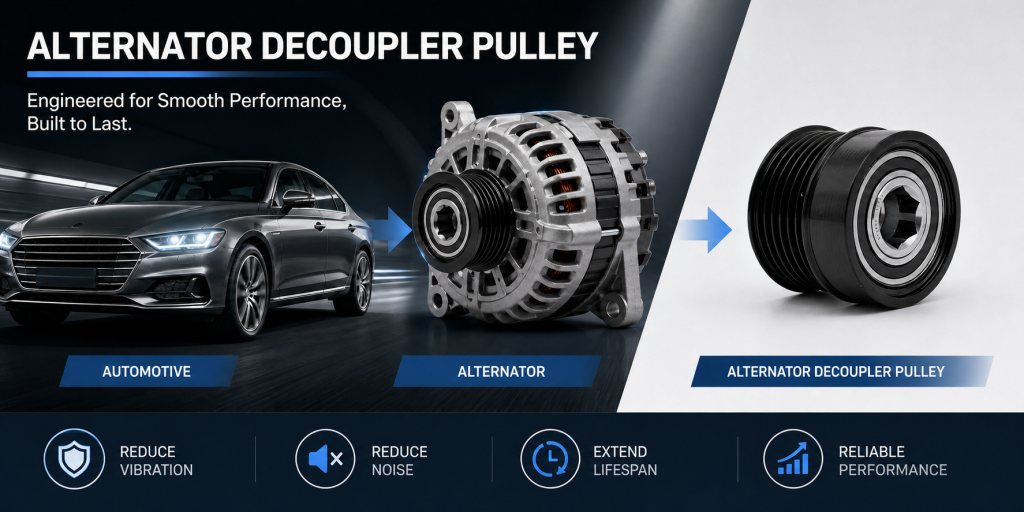
In a modern vehicle’s accessory drive system, the alternator does more than simply generate electricity. Because engine speed constantly changes during acceleration, deceleration, gear shifts, and start-stop operation, the alternator and serpentine belt are exposed to repeated speed fluctuations and vibration.
An alternator decoupler pulley is designed to help manage these fluctuations. By allowing controlled relative movement between the alternator and the belt drive, it can reduce belt vibration, improve accessory drive stability, and help extend the service life of related components.
As a manufacturer of automotive pulleys, Fuyide explains what an alternator decoupler pulley is, how it works, why it matters, and what to consider when selecting a replacement.
What Is an Alternator Decoupler Pulley?
An alternator decoupler pulley, often abbreviated as ADP, is a specialized pulley mounted on the alternator shaft. Unlike a conventional solid alternator pulley, it incorporates an internal mechanism that helps isolate the alternator from torsional vibrations and sudden speed changes in the engine accessory drive system.
The alternator rotor has relatively high rotational inertia. When engine speed drops rapidly, the rotor naturally tends to keep spinning. With a conventional solid pulley, this inertia is transmitted directly to the serpentine belt, which can cause belt flutter, tensioner movement, noise, and additional stress on drive components.
A decoupler pulley helps absorb or isolate these rotational irregularities, allowing the belt drive system to operate more smoothly.
How Does an Alternator Decoupler Pulley Work?
The crankshaft drives the serpentine belt, which in turn rotates the alternator pulley and alternator rotor. However, the crankshaft does not rotate at a perfectly constant speed, especially in internal combustion engines where combustion pulses continuously create torsional fluctuations.
An alternator decoupler pulley uses an internal decoupling mechanism to reduce the impact of these fluctuations.
Depending on its design, the pulley may allow limited rotational movement and vibration isolation between the belt pulley and alternator shaft. This helps prevent sudden engine speed changes from being transferred directly through the entire accessory belt drive.
As a result, the system can achieve:
Reduced serpentine belt vibration and flutter
Smoother tensioner operation
Lower noise and vibration
Reduced loads on accessory drive components
Improved overall belt drive stability
Alternator Decoupler Pulley vs. Overrunning Alternator Pulley
Alternator decoupler pulleys are sometimes confused with overrunning alternator pulleys (OAPs). Although both are designed to improve accessory drive performance, they are not exactly the same.
An Overrunning Alternator Pulley (OAP) typically uses a one-way clutch mechanism. It drives the alternator in one direction while allowing the alternator rotor to overrun or freewheel when engine speed decreases quickly.
An Overrunning Alternator Decoupler (OAD) generally provides both overrunning capability and additional torsional isolation through an internal spring or damping mechanism.
Because pulley designs vary by vehicle and alternator application, an OAP and an OAD should not automatically be considered interchangeable. The correct pulley should match the vehicle manufacturer’s specifications and the specific alternator design.
Why Is the Alternator Decoupler Pulley Important?
Modern automotive engines are designed for higher efficiency, lower emissions, and improved driving comfort. At the same time, accessory drive systems must handle frequent speed changes and increasingly complex operating conditions.
The alternator decoupler pulley plays an important role in controlling torsional vibration in this system.
Reducing vibration can help protect not only the serpentine belt but also the belt tensioner, idler pulleys, alternator bearings, and other associated components. It can also contribute to quieter and smoother vehicle operation.
A properly functioning pulley therefore supports the reliability of the entire front-end accessory drive (FEAD) system rather than simply affecting the alternator itself.

What Are the Symptoms of a Bad Alternator Decoupler Pulley?
Like other mechanical components, an alternator decoupler pulley can wear over time. Internal bearings, clutch elements, springs, or damping components may gradually lose their intended performance.
Common symptoms may include:
Excessive serpentine belt vibration
Abnormal belt tensioner movement
Squeaking, rattling, or chirping noises
Noise when starting or shutting down the engine
Premature serpentine belt wear
A pulley that locks or rotates abnormally
Increased vibration from the accessory drive system
These symptoms can also result from other belt drive problems, so proper inspection is important before replacing the pulley.
What Happens If an Alternator Decoupler Pulley Fails?
A failed pulley may no longer isolate alternator inertia and engine speed fluctuations effectively. If it becomes seized, worn, or damaged, additional dynamic loads can be transmitted to the belt and tensioner.
Continued operation may contribute to accelerated wear of the serpentine belt, tensioner, idler pulleys, alternator bearings, and related components. In severe cases, belt failure can affect multiple engine accessories driven by the same belt.
For this reason, the condition of the alternator pulley should be checked whenever abnormal belt movement or accessory drive noise is detected.
What Makes a Quality Alternator Decoupler Pulley?
For distributors, wholesalers, automotive aftermarket brands, and repair professionals, pulley quality directly influences reliability and service life.
A high-quality alternator decoupler pulley requires attention to several factors, including dimensional accuracy, material selection, internal mechanism performance, bearing quality, surface treatment, and production consistency.
Precision machining is particularly important because the pulley operates continuously at high rotational speeds. Accurate dimensions and proper concentricity help maintain stable rotation and reduce unnecessary vibration.
Manufacturing quality should therefore be considered alongside vehicle compatibility and price when sourcing replacement alternator pulleys.
How to Choose the Correct Alternator Decoupler Pulley
Not every alternator pulley fits every vehicle. Buyers should verify the application carefully before installation.
Key specifications can include vehicle make and model, model year, engine type, alternator model, OEM or OE reference number, pulley diameter, number of grooves, thread dimensions, and pulley type.
For aftermarket distributors and importers, providing accurate OE cross-reference information can significantly reduce incorrect ordering and application issues.
Fuyide Alternator Pulley Solutions
As an automotive pulley manufacturer, Fuyide focuses on producing pulley solutions for automotive aftermarket and B2B customers.
From material selection and precision machining to assembly and quality inspection, manufacturing consistency is essential for delivering reliable alternator pulley performance. Fuyide can support distributors, wholesalers, automotive parts brands, and other professional buyers with alternator pulley products for different vehicle applications.
For customers sourcing alternator decoupler pulleys in bulk, detailed product specifications and OE references can be used to identify suitable models and discuss specific purchasing requirements.
Conclusion
The alternator decoupler pulley may be a relatively small component, but it has an important function within a modern vehicle’s accessory drive system. By helping isolate alternator inertia and torsional vibration, it can reduce belt fluctuation, improve tensioner stability, lower noise, and reduce unnecessary stress on related components.
Choosing the correct, well-manufactured pulley is therefore important for both replacement performance and long-term accessory drive reliability.
Looking for an alternator decoupler pulley manufacturer or supplier?
Contact Fuyide with your OE number, alternator model, vehicle application, or product specifications to discuss available alternator pulley solutions and B2B sourcing requirements.
Related Products
Frequently Asked Questions
What is an alternator decoupler pulley?
An alternator decoupler pulley (OAD) is a specialized pulley installed on an alternator shaft to help control torsional vibration and alternator inertia. It can reduce belt vibration, tensioner movement, noise, and dynamic loads in the front-end accessory drive (FEAD) system.
What is the difference between an OAD and an OAP?
An OAD (Overrunning Alternator Decoupler) combines overrunning capability with torsional damping, typically using an internal spring or damping mechanism. An OAP (Overrunning Alternator Pulley) primarily uses a one-way clutch to allow the alternator to overrun during rapid engine speed changes. They are not automatically interchangeable and must match the vehicle and alternator application.
What are the symptoms of a bad alternator decoupler pulley?
Common symptoms include excessive serpentine belt vibration, abnormal tensioner movement, squeaking or rattling noises, noise during engine start-up or shutdown, premature belt wear, and abnormal pulley rotation. These symptoms can also be caused by other FEAD components, so the complete accessory drive system should be inspected before replacement.
How do I choose the correct alternator decoupler pulley?
To select the correct OAD, buyers should verify the vehicle make, model and engine, alternator model, OE or OEM reference number, pulley diameter, number of grooves, thread dimensions, and pulley type. For aftermarket sourcing, distributors and importers should also verify OE cross-references, application coverage, quality requirements, and bulk purchasing specifications with the manufacturer.