


Quick answer
When sourcing alternator pulleys for Southeast Asia, distributors should prioritize vehicle application coverage, verified pulley OE cross references, OAP/OAD compatibility, product quality, and total landed cost. Market requirements differ across Vietnam, Thailand, Indonesia, Malaysia, and the Philippines, so buyers should build SKU lists using local vehicle demand and confirmed alternator specifications. Supplier evaluation should also cover inspection procedures, packaging, order quantities, and shipping arrangements.
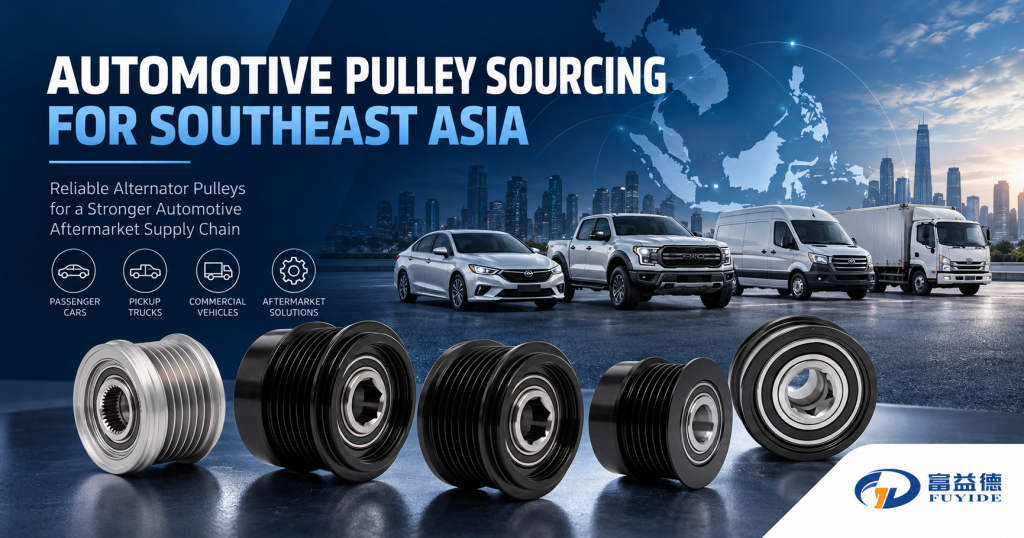
Southeast Asia is an important market for automotive aftermarket parts, driven by diverse vehicle populations, growing transportation needs, and demand for cost-effective replacement components.
For automotive parts importers and distributors, sourcing the right products requires more than finding the lowest unit price. Vehicle compatibility, product reliability, inventory management, and supplier responsiveness all influence long-term business performance.
Automotive pulleys, particularly overrunning alternator pulleys (OAP) and alternator decoupler pulleys (OAD), are important components in modern engine accessory drive systems.
As a result, selecting a suitable alternator pulley supplier can help distributors maintain product availability while meeting different customer expectations.
This guide explores the key factors automotive aftermarket buyers should consider when sourcing automotive pulleys for Southeast Asian markets.
1. Understanding the Southeast Asian Automotive Aftermarket
Southeast Asia includes several automotive markets with different vehicle preferences, purchasing behaviors, and distribution structures.
Countries such as Thailand, Indonesia, Malaysia, Vietnam, and the Philippines have significant demand for vehicle maintenance and replacement parts.
However, vehicle populations and aftermarket requirements vary considerably between countries.
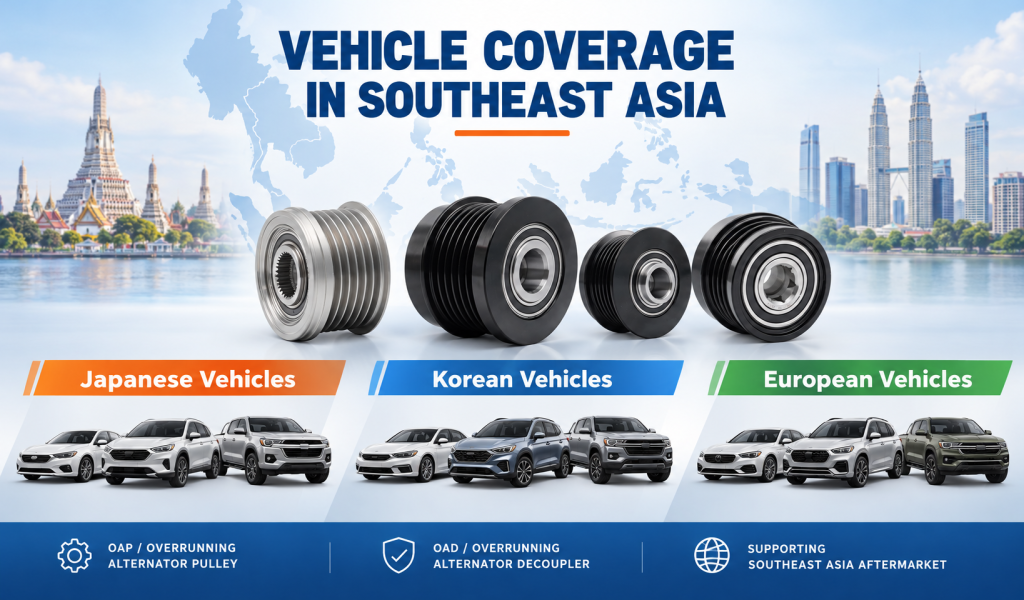
Japanese Vehicles Remain Important
Japanese automotive brands have a strong presence in many Southeast Asian markets.
Common examples include:
Toyota
Honda
Mitsubishi
Nissan
Isuzu
Suzuki
These manufacturers offer passenger cars, pickup trucks, SUVs, and commercial vehicles that serve different transportation needs.
For aftermarket distributors, Japanese vehicle applications often represent an important part of their product portfolio.
However, buyers should not assume that all vehicles from the same manufacturer use identical alternator pulley designs.
Different engines, alternator suppliers, and production years may require different components.
Korean and European Vehicle Applications
Korean manufacturers such as Hyundai and Kia also contribute to regional aftermarket demand.
European automotive brands, including Volkswagen, BMW, Mercedes-Benz, and others, are present in selected passenger vehicle and commercial vehicle segments.
European applications may require different alternator pulley specifications, depending on the engine and accessory drive design.
Therefore, distributors serving multiple vehicle segments need accurate product identification and cross-reference information.
Different Countries Require Different Product Strategies
Vehicle demand varies across Southeast Asia.
For example, Thailand has an established pickup truck and commercial vehicle market, while Indonesia has a large passenger vehicle population.
Malaysia also has a distinctive vehicle mix that includes domestic brands alongside Japanese, Korean, and European manufacturers.
For distributors, these differences highlight the importance of developing country-specific product portfolios rather than relying on a single regional product list.
Suggested Image 1: Southeast Asian Automotive Aftermarket Overview
A professional infographic featuring a Southeast Asia map, passenger cars, pickup trucks, commercial vehicles, and automotive pulley components.
Alt Text: Southeast Asian automotive aftermarket showing diverse vehicle applications and automotive pulley sourcing opportunities.
2. Why Vehicle Coverage Matters When Sourcing Automotive Pulleys
Vehicle coverage is one of the most important considerations for automotive aftermarket distributors.
A competitive price offers limited value if a product does not match the intended vehicle application.
Understanding Alternator Pulley Compatibility
Alternator pulleys may differ in several technical specifications:
Pulley diameter
Number of belt grooves
Pulley offset
Mounting interface
Internal clutch mechanism
OAP or OAD design
Alternator compatibility
Even when two pulleys have similar external dimensions, their internal mechanisms may differ.
For example, an overrunning alternator pulley and an alternator decoupler pulley are not automatically interchangeable.
Using an incorrect replacement pulley may affect accessory belt performance and create additional maintenance problems.
OEM Part Numbers and Cross-References
OEM part numbers provide an important starting point when identifying suitable replacement parts.
For distributors handling multiple vehicle brands, accurate cross-reference information can improve product selection efficiency.
A useful product catalog should ideally include:
Product reference number.
Applicable OEM numbers.
Supported vehicle applications.
Alternator references where available.
Relevant dimensions and technical specifications.
However, buyers should verify the accuracy of cross-reference information before confirming large orders.
Prioritizing High-Demand Applications
Importers do not necessarily need to stock every available pulley model.
Instead, they can prioritize products according to local vehicle populations, historical sales data, repair demand, and customer inquiries.
For example, a distributor primarily serving Japanese passenger cars may require a different inventory structure from a distributor supplying European commercial vehicles.
A focused product range can help improve inventory turnover and reduce slow-moving stock.
3. Balancing Quality and Cost in Southeast Asian Markets
Price competitiveness is a major consideration for automotive parts buyers across many Southeast Asian markets.
However, the lowest purchasing price does not always produce the lowest overall business cost.
Automotive pulleys operate under changing rotational speeds, temperature conditions, and mechanical loads.
Poor product consistency can create problems for distributors, repair workshops, and vehicle owners.
Why Product Quality Matters
An automotive alternator pulley must operate reliably within its intended accessory drive system.
Depending on the design, key performance considerations may include:
Consistent clutch engagement.
Reliable overrunning function.
Appropriate torsional characteristics for OAD designs.
Dimensional accuracy.
Wear resistance.
Corrosion protection.
Stable operation under specified conditions.
For aftermarket distributors, quality problems may result in increased warranty claims, customer complaints, and replacement costs.
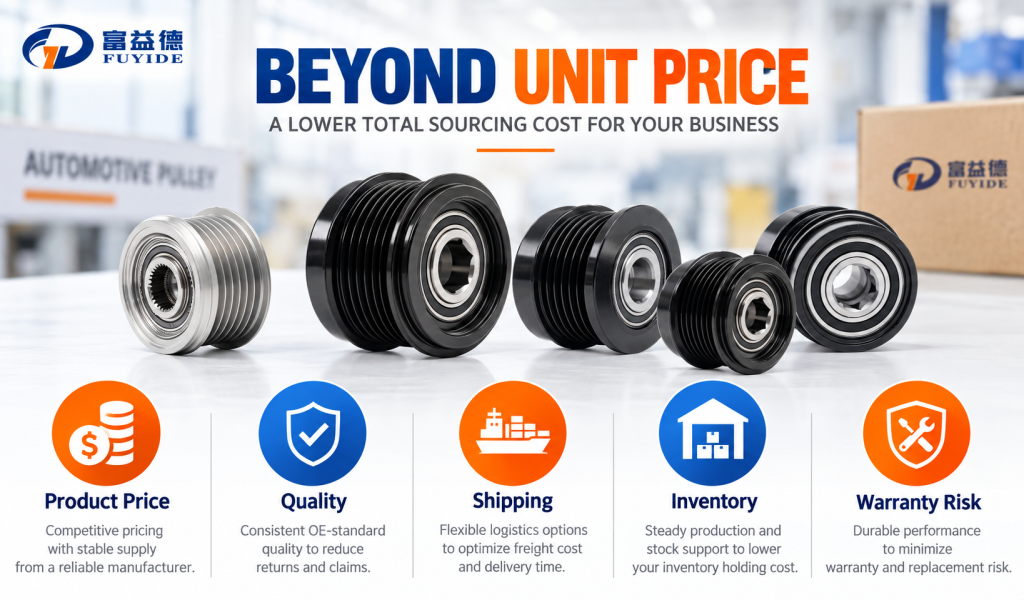
Understanding Total Procurement Cost
When comparing suppliers, buyers should evaluate more than the quoted unit price.
The total procurement cost may include:
| Cost Factor | Why It Matters |
| Product Price | Direct purchasing expense |
| Shipping Cost | Influences landed cost |
| Import Duties and Taxes | Vary by destination and product classification |
| Packaging | Affects transportation protection and retail presentation |
| Quality Issues | May increase returns and warranty costs |
| Inventory Holding | Ties up working capital |
| Delivery Reliability | Influences stock availability |
A slightly higher-priced product with reliable quality and accurate compatibility information may offer better long-term value than a cheaper alternative with inconsistent performance.
Avoiding the Lowest-Price Trap
Distributors should be cautious when supplier quotations differ significantly.
Price differences may reflect variations in materials, manufacturing processes, inspection requirements, packaging, or commercial terms.
Before choosing a supplier, buyers should clarify the product specifications and quality expectations associated with each quotation.
Suggested Image 2: Automotive Pulley Quality and Cost Comparison
A professional infographic comparing unit price, product consistency, shipping cost, warranty risk, and inventory cost.
Alt Text: Automotive pulley sourcing cost comparison showing key factors affecting total procurement expenses.
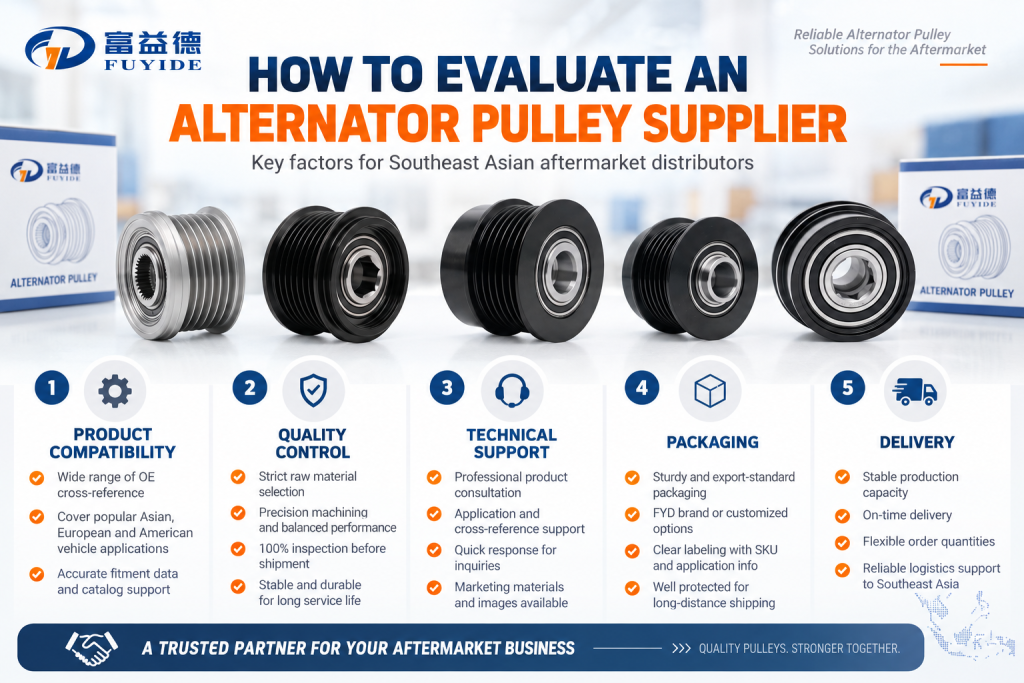
4. How to Evaluate an Alternator Pulley Supplier
Finding a suitable alternator pulley supplier involves evaluating technical capabilities, product consistency, and commercial communication.
For international importers, supplier reliability is particularly important because overseas sourcing involves longer supply chains and additional coordination.
Product Knowledge and Technical Support
A supplier should be able to communicate clearly about product specifications and application requirements.
For alternator pulleys, useful technical information may include:
Product dimensions.
Belt groove specifications.
OEM cross-reference numbers.
Alternator compatibility.
OAP or OAD classification.
Available product identification information.
Technical communication can help buyers reduce ordering mistakes, especially when sourcing unfamiliar applications.
Manufacturing and Quality Control
Automotive pulleys require appropriate manufacturing and inspection processes.
Depending on the product design, quality checks may involve dimensional inspection, functional testing, visual inspection, and other relevant verification procedures.
Buyers can ask suppliers about their inspection methods and request supporting documentation where appropriate.
Supplier claims about certifications or testing capabilities should be verified rather than assumed.
Product Consistency
A sample that performs well does not automatically guarantee consistent quality across future production batches.
Importers should clarify how suppliers maintain product consistency and manage quality-related issues.
For repeat orders, consistent specifications are particularly important.
Communication and Delivery
Clear communication helps avoid misunderstandings about part numbers, quantities, packaging, and delivery arrangements.
Before placing a bulk order, buyers should confirm the agreed commercial terms, production schedule, shipping arrangements, and inspection requirements.
Suggested Image 3: Automotive Pulley Supplier Evaluation
A clean B2B infographic showing supplier evaluation criteria: product compatibility, quality control, technical support, packaging, and delivery reliability.
Alt Text: Alternator pulley supplier evaluation checklist for Southeast Asian automotive aftermarket importers.
5. Building an Efficient Automotive Pulley Inventory
Inventory management can be challenging for automotive aftermarket distributors because different vehicle applications require different components.
Stocking too many slow-moving models can increase costs, while insufficient inventory of popular products can lead to lost sales.
Use Local Vehicle Demand to Guide Purchasing
Distributors should analyze their target markets before selecting products.
Useful information includes:
Common vehicle models.
Vehicle age distribution.
Frequently requested replacement parts.
Historical sales performance.
Workshop and retailer feedback.
This information helps identify which automotive pulley applications deserve priority.
Divide Products into Inventory Categories
An ABC inventory approach can help distributors allocate purchasing budgets.
Category A: High-Demand Products
Frequently ordered items that require reliable stock availability.
Category B: Medium-Demand Products
Products with steady but less frequent sales.
Category C: Low-Demand Products
Specialized applications or products purchased occasionally.
This approach helps buyers manage capital while maintaining reasonable product coverage.
Consider Mixed-Model Orders
For distributors testing new product lines, mixed-model orders may offer greater flexibility than purchasing large quantities of a single reference.
However, mixed-order availability, minimum order quantities, and pricing depend on the supplier’s commercial terms.
These conditions should be confirmed before ordering.
6. Packaging and Logistics for Southeast Asian Importers
International shipping introduces additional considerations beyond product manufacturing.
Automotive pulleys contain mechanical components that should be protected from contamination, moisture, and physical damage.
Protective Packaging
Suitable packaging can help reduce damage during handling and transportation.
Depending on the product and shipment requirements, packaging considerations may include:
Individual product protection.
Moisture-resistant packaging.
Clear product identification labels.
Strong outer cartons.
Appropriate carton weight.
Secure palletization where required.
For distributors, accurate labeling is particularly important when shipments contain multiple product references.
Private Label Packaging
Some automotive aftermarket distributors develop their own brands.
Private label packaging can support brand recognition and retail presentation.
However, buyers should confirm packaging specifications, labeling requirements, intellectual property considerations, and minimum order quantities before placing an order.
Shipping and Import Documentation
Importers should confirm the documents required for their destination market.
Depending on the transaction, these may include commercial invoices, packing lists, transport documents, certificates of origin, and other applicable documents.
Import duties, taxes, and regulatory requirements vary by country and product classification.
Buyers should verify current requirements with their customs broker or relevant local authorities.
7. Common Sourcing Mistakes to Avoid
Automotive aftermarket buyers can reduce procurement risks by avoiding several common mistakes.
Choosing Products Based Only on Appearance
Two pulleys may look similar but have different internal mechanisms or installation specifications.
Always verify compatibility using reliable product information.
Focusing Only on Unit Price
Low prices may be attractive, but product quality, warranty costs, and supply reliability also affect profitability.
Evaluate the total cost of sourcing rather than the purchase price alone.
Ignoring Country-Specific Vehicle Demand
The Southeast Asian market is diverse.
A product range suitable for one country may not match demand in another.
Use local sales information and vehicle application data to guide inventory decisions.
Placing Large Orders Without Verification
Before purchasing large quantities of unfamiliar products, buyers should consider sample evaluation and appropriate technical verification.
This is especially important when replacing existing suppliers or introducing new product references.
Overlooking Packaging and Labeling
Incorrect labels or inadequate packaging can create receiving errors, inventory confusion, and transportation damage.
Clear packaging specifications should be included in purchasing agreements.
8. Frequently Asked Questions
What should Southeast Asian distributors consider when sourcing automotive pulleys?
Important factors include vehicle compatibility, product quality, OEM cross-reference accuracy, supplier communication, pricing, packaging, and delivery reliability.
Are Japanese vehicle applications important in Southeast Asia?
Yes. Japanese manufacturers have a significant presence in many Southeast Asian automotive markets.
However, the exact vehicle mix differs by country, so distributors should use local market information to determine which applications to stock.
How can importers reduce automotive pulley sourcing costs?
Importers can review shipping arrangements, optimize order quantities, improve inventory planning, and reduce compatibility-related returns.
Cost reduction should not compromise required product quality or application accuracy.
What information should buyers provide to an alternator pulley supplier?
Useful information includes OEM part numbers, alternator references, vehicle applications, required quantities, packaging preferences, and destination market.
Can automotive pulley suppliers provide private label packaging?
Some suppliers offer private label packaging, but capabilities and minimum order requirements vary.
Buyers should confirm availability directly with their selected supplier.
9. Source Automotive Pulleys for Your Southeast Asian Aftermarket Business
Sourcing automotive pulleys for Southeast Asia requires a balance between vehicle coverage, product reliability, and competitive procurement costs.
For importers and distributors, understanding local vehicle demand is essential when building a suitable aftermarket product portfolio.
Accurate compatibility information, consistent product specifications, and effective inventory planning can help reduce purchasing risks and support long-term customer relationships.
FUYIDE focuses on automotive alternator pulley products for aftermarket applications.
If you are looking for an alternator pulley supplier for your automotive parts distribution business, contact FUYIDE to discuss your product requirements, available references, and sourcing needs.
Contact FUYIDE
Website: https://fyd-pulley.com/
Email: czfyd@fyd-cn.com
WhatsApp: +86 18915000258
Related Products
Frequently Asked Questions
Why is vehicle coverage important when sourcing alternator pulleys?
Vehicle coverage determines whether a distributor's inventory matches the applications demanded by local customers. Because similar vehicles may use different alternator configurations, coverage should be verified using OE references, engine codes, and technical specifications.
Should distributors compare alternator pulley prices or total landed costs?
Distributors should compare total landed costs, including product price, freight, import duties, taxes, customs clearance, and applicable handling expenses. Unit price alone may not accurately represent the total cost of supplying a destination market.
Can buyers combine OAP and OAD models in one wholesale order?
Buyers may be able to combine different OAP and OAD references when the supplier supports mixed-SKU purchasing. Minimum order quantities, availability, pricing, and shipment arrangements should be confirmed before placing an order.
What information should a Southeast Asian distributor include in an RFQ?
An RFQ should include the required pulley OE or verified cross-reference numbers, alternator references, target vehicle applications, product types, quantities, destination country, packaging requirements, and requested delivery terms.