


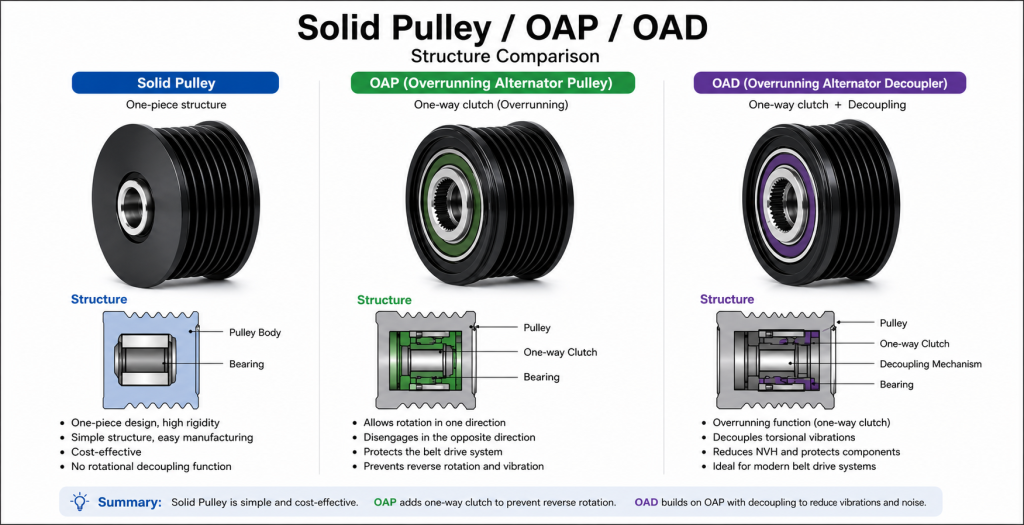
(“Structural Comparison: Solid Pulley vs. OAP vs. OAD”)
Not all alternator pulleys work in the same way.
Although an overrunning alternator pulley (OAP) and a conventional solid alternator pulley may look similar from the outside, their internal designs and operating characteristics are significantly different.
A solid pulley creates a direct mechanical connection between the accessory belt and the alternator shaft. An OAP pulley, on the other hand, incorporates a one-way clutch mechanism that allows the alternator to overrun under certain operating conditions.
Why does this difference matter? Can an OAP be replaced with a solid pulley? And what should automotive aftermarket distributors consider when sourcing alternator pulleys?
In this guide, FUYIDE explains the key differences between an overrunning alternator pulley and a solid pulley, how each design works, and why correct product selection matters for the entire accessory belt drive system.
What Is an Overrunning Alternator Pulley?
An overrunning alternator pulley, commonly abbreviated as OAP, is an alternator pulley incorporating a one-way clutch mechanism.
During normal operation, the OAP transfers torque from the accessory belt to the alternator. However, when engine speed decreases rapidly, the pulley can allow the alternator rotor to temporarily overrun instead of forcing it to decelerate immediately with the belt.
This is important because the alternator rotor has rotational inertia.
The engine continuously experiences changes in rotational speed due to combustion events, acceleration, deceleration, gear changes and other operating conditions. An OAP helps isolate some of these rotational irregularities from the accessory drive system.
An OAP may also be referred to in the automotive aftermarket as an:
Alternator overrunning pulley
Overrunning pulley
Alternator freewheel pulley
Freewheeling alternator pulley
Despite the different terminology, the defining feature of an OAP is its one-way overrunning function.
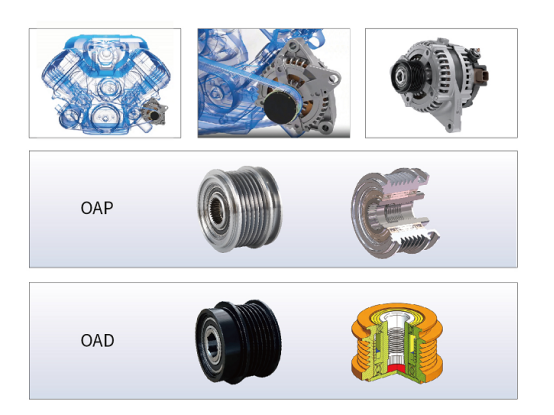
Related reading: What Is an Overrunning Alternator Pulley (OAP) and How Does It Work?
What Is a Solid Alternator Pulley?
A solid alternator pulley uses a much simpler design.
It establishes a direct mechanical connection between the accessory belt and the alternator shaft. When the belt accelerates, the alternator accelerates with it. When belt speed decreases, the alternator is also forced to decelerate accordingly.
Unlike an overrunning alternator pulley, a solid pulley does not contain a one-way clutch that allows the alternator rotor to overrun.
Solid alternator pulleys have been widely used in automotive applications and can still be the correct design for vehicles engineered to use them.
Therefore, “OAP vs. solid pulley” is not simply a question of which product is better. The correct pulley depends on the design and requirements of the specific vehicle application.
How Does an OAP Pulley Work?
The main difference becomes easier to understand when looking at engine deceleration.
During acceleration:
Engine → Accessory Belt → OAP → Alternator
The belt drives the OAP, the internal clutch engages, and torque is transmitted to the alternator.
During rapid engine deceleration:
Engine slows → Belt slows → Alternator retains rotational inertia → OAP allows overrunning
Instead of forcing the alternator rotor to immediately follow the lower belt speed, the OAP allows the rotor to temporarily continue rotating.
A solid alternator pulley cannot provide this overrunning behavior because the pulley and alternator shaft remain mechanically coupled.
This one-way function is the fundamental technical difference between an OAP and a solid pulley.
OAP vs. Solid Pulley: Key Differences
For buyers and automotive parts distributors, the major differences can be summarized as follows.
Internal Design
A solid alternator pulley has a relatively simple fixed structure.
An OAP pulley incorporates an internal one-way clutch or overrunning mechanism.
Rotational Behavior
A solid pulley directly follows accessory belt speed in both acceleration and deceleration.
An OAP transmits torque in the driving direction but allows overrunning under appropriate operating conditions.
Management of Alternator Inertia
The alternator rotor has rotational mass and therefore retains inertia when engine speed changes.
An OAP helps manage the effect of this inertia on the accessory belt drive, particularly during rapid engine speed changes.
Belt Drive Behavior
Depending on the FEAD system design, an OAP can help reduce excessive belt vibration and tensioner movement associated with rotational irregularities.
Application
Both types have valid automotive applications.
The correct choice should be determined by OE specifications, alternator configuration and verified vehicle fitment data—not simply by appearance, dimensions or price.
Why Is Alternator Inertia Important?
To understand why automotive engineers use an overrunning alternator pulley, it is useful to understand rotational inertia.
The alternator rotor can rotate at high speed. When the engine suddenly slows down, the alternator rotor naturally tends to continue rotating.
With a solid pulley, the belt must act directly against this rotational inertia because the alternator remains coupled to the belt drive.
With an OAP, the internal one-way mechanism can temporarily separate the alternator rotor’s higher rotational speed from the slowing accessory belt.
This helps reduce the transmission of certain dynamic forces into the Front End Accessory Drive (FEAD).
For this reason, the OAP should be considered as part of the complete belt drive system rather than as an isolated alternator component.
What Are the Benefits of an Overrunning Alternator Pulley?
When specified for the vehicle and operating correctly, an OAP may contribute to:
Smoother accessory belt operation
Reduced excessive belt vibration
Reduced tensioner movement
Better management of alternator rotational inertia
Reduced noise and vibration in the accessory drive
Lower dynamic loads on related FEAD components
Improved overall accessory drive behavior
The exact effect depends on the engine, alternator, belt drive configuration and vehicle design.
For automotive aftermarket buyers, this is also why correct application matching is important. A pulley is not simply a metal wheel with the correct dimensions; its internal operating characteristics are part of the application.
Is an OAP Always Better Than a Solid Pulley?
No.
An OAP is a more functionally complex component, but that does not mean every vehicle requires one.
If a vehicle was designed to operate with a solid alternator pulley, the correct replacement may still be a solid pulley.
Similarly, where the original application specifies an OAP, an appropriate OAP should be selected according to verified application information.
The correct principle is therefore:
Choose the pulley engineered for the application rather than assuming one pulley technology is universally better.
This is particularly important for aftermarket distributors managing products for many different vehicle brands, engines and alternator systems.
Can You Replace an OAP with a Solid Alternator Pulley?
An OAP should not automatically be replaced by a solid pulley simply because the mounting dimensions appear compatible.
Doing so changes how the alternator interacts dynamically with the accessory belt system.
If the original system was engineered around an overrunning function, using a solid pulley may alter belt and tensioner behavior.
For replacement applications, buyers and technicians should verify:
OE part number
Vehicle make and model
Model year
Engine
Alternator manufacturer
Alternator reference number
Pulley dimensions
Pulley type
Verified cross-reference data
Visual similarity alone is not sufficient to determine interchangeability.
What About OAP vs. OAD?
Another common source of confusion is the difference between OAP and OAD.
OAP means Overrunning Alternator Pulley.
OAD means Overrunning Alternator Decoupler.
Both can provide overrunning behavior, but an OAD generally incorporates additional decoupling, spring or damping characteristics.
As a result, an OAP, OAD and solid pulley should not be treated as three interchangeable versions of the same component.
Correct identification is essential.
For a deeper explanation, read: OAP vs. OAD: Understanding the Difference in Alternator Pulley Technology.