


Quick answer
Automotive parts distributors should build their pulley SKU mix based on local vehicle demand, fleet composition, aftermarket sales data, and supplier availability. A balanced range of overrunning alternator pulleys (OAPs), overrunning alternator decouplers (OADs), and other relevant pulley types can help distributors improve product coverage, reduce slow-moving inventory, and meet more replacement-part demands. FYD Pulley supports aftermarket buyers with automotive pulley sourcing solutions.
Meta Title: How to Build the Right Alternator Pulley SKU Mix | FUYIDE
Meta Description: Learn how automotive parts distributors can select the right alternator pulley SKUs based on local vehicle parc, OE numbers, engine applications, and aftermarket demand.
Introduction: Why Buying More Pulley SKUs Doesn’t Always Mean Better Sales
For automotive parts distributors, building a profitable product inventory is not simply about purchasing more products.
It is about purchasing the right products.
This is especially important in the automotive aftermarket, where vehicle models, engine configurations, production years, and OE specifications can significantly influence replacement parts demand.
Consider two automotive parts distributors operating in different European markets.
One distributor serves a small town in Germany where Volkswagen, Audi, BMW, and Mercedes-Benz vehicles represent a significant portion of the local vehicle population.
Another distributor operates in a French regional market where Renault, Peugeot, Citroën, and other European brands are commonly serviced.
Both distributors sell alternator pulleys.
However, should they purchase exactly the same pulley models and quantities?
Probably not.
Their local vehicle populations, repair demand, and replacement part requirements may be substantially different.
For an Automotive Parts Distributor, a well-planned pulley product range can improve product availability, reduce slow-moving inventory, and support more efficient purchasing decisions.
In this article, we explain how distributors can develop a practical alternator pulley SKU strategy based on their local market.

parts demand. (Illustrative image)
1. Start with Your Local Vehicle Parc, Not a Supplier’s Product Catalog
One of the most common inventory planning mistakes is selecting products based primarily on a supplier’s catalog.
A supplier may offer hundreds of alternator pulley references.
However, this does not mean every reference is equally relevant to your local market.
A better starting point is understanding your local vehicle parc.
What Is Vehicle Parc?
Vehicle parc refers to the total population of vehicles currently in use within a specific geographic market.
For automotive parts distributors, vehicle parc data can provide useful information about:
The most common vehicle brands and models
Vehicle production years and age distribution
Engine types and configurations
Diesel versus gasoline vehicle populations
Potential replacement parts demand
For example, a distributor serving a market with a large population of older diesel-powered European vehicles may need a different alternator pulley assortment than a distributor serving a market dominated by newer gasoline-powered vehicles.
This distinction matters because alternator pulley applications are often engine-specific rather than simply vehicle-brand-specific.
A Practical Example: A Small European Town
Imagine an independent automotive parts distributor serving a town and its surrounding communities.
Its customers include local repair workshops, independent garages, and small automotive service businesses.
The distributor has limited warehouse space and cannot afford to stock every alternator pulley available in the aftermarket.
Instead of purchasing a large quantity of random pulley references, the distributor begins by studying the vehicles most frequently serviced by its customers.
It discovers that several Volkswagen Group models, along with selected Renault, Peugeot, and Ford vehicles, account for a substantial share of workshop visits.
This information becomes the foundation of its pulley purchasing strategy.
The goal is not to stock the largest pulley catalog. The goal is to cover the vehicles most likely to need replacement parts.
2. Identify the Vehicle Models That Generate Aftermarket Demand
After understanding the local vehicle population, the next step is identifying the models most relevant to aftermarket repair demand.
Not every vehicle in the local market creates the same opportunity for replacement parts distributors.
Vehicle age, mileage, maintenance patterns, and component durability all influence demand.
For alternator pulleys, distributors should pay particular attention to vehicles with meaningful populations and established aftermarket service activity.
Vehicle Brand Alone Is Not Enough
A common mistake is assuming that a pulley suitable for one Volkswagen vehicle will automatically fit other Volkswagen models.
In reality, alternator pulley compatibility can depend on several factors, including:
Vehicle model and production year
Engine code and engine configuration
Alternator manufacturer and specification
Original equipment part number
Pulley dimensions and technical design
Even vehicles sharing the same model name may require different alternator pulley references.
Therefore, distributors should move from general vehicle-brand analysis to more precise application research.
Example of Vehicle Application Planning
Consider a distributor researching these vehicle groups:
| Vehicle Brand | Example Models | Important Research Factors |
| Volkswagen | Golf, Passat, Polo | Engine codes, production years, alternator specifications |
| Audi | A3, A4, A6 | Engine variants and OE references |
| BMW | 1 Series, 3 Series, 5 Series | Engine applications and alternator types |
| Renault | Clio, Megane, Scenic | Engine configurations and OE numbers |
| Peugeot | 208, 308, 3008 | Production years and alternator applications |
| Ford | Focus, Fiesta, Mondeo | Engine variants and alternator specifications |
Note: These are examples of vehicle groups for market research, not confirmed fitment claims for specific FUYIDE products.
By organizing vehicles into application groups, distributors can identify where pulley demand is likely to concentrate.
This creates a more reliable basis for selecting SKUs.
3. Move from Vehicle Models to Engine Applications
Once the most relevant vehicle models have been identified, the next step is engine-level analysis.
This is one of the most important stages in building an accurate pulley product range.
Two vehicles with similar model names may use different engines.
Different engine configurations may require different alternator assemblies and pulley specifications.
As a result, selecting pulleys based only on vehicle model information increases the risk of incorrect purchasing.
Why Engine Information Matters
An alternator pulley is part of the engine accessory drive system.
Depending on the application, the alternator pulley may be designed to help manage rotational fluctuations and improve belt-drive operation.
Many modern vehicles use overrunning alternator pulleys or overrunning alternator decouplers.
These components are engineered for specific alternator and engine applications.
Distributors should therefore verify compatibility using reliable technical information.
Important information may include:
Engine identification: The engine code or precise engine variant.
Production period: The relevant vehicle manufacturing dates.
Alternator specification: The alternator manufacturer, model, and applicable OE reference.
Pulley configuration: The pulley type, dimensions, and technical requirements.
This process helps prevent a distributor from ordering a pulley that appears visually similar but is not suitable for the intended vehicle.
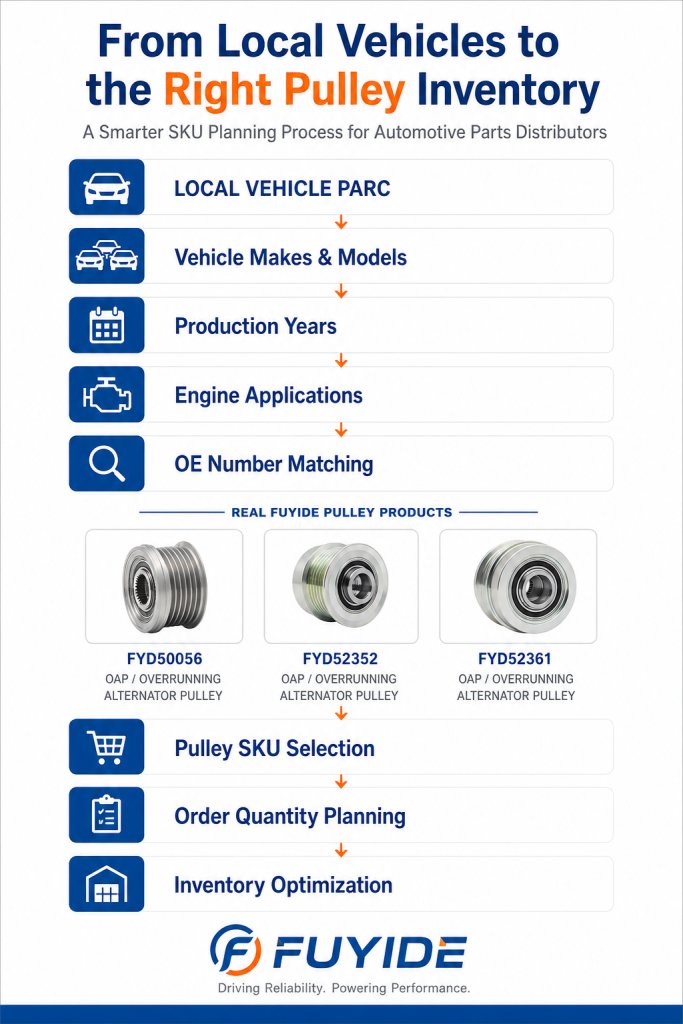
essential for selecting replacement pulleys. (Illustrative image)
4. Use OE Numbers to Improve Pulley Product Matching
After identifying relevant vehicle and engine applications, distributors should connect those applications to verified OE numbers.
An OE number is an important reference used to identify original equipment components and their corresponding replacement parts.
For an Automotive Parts Distributor, accurate OE cross-referencing is essential for building a dependable aftermarket inventory.
Why OE Number Matching Matters
A single aftermarket pulley reference may correspond to multiple compatible OE numbers.
Conversely, similar-looking pulleys may have different technical specifications and may not be interchangeable.
Therefore, product selection should not depend on appearance alone.
A reliable matching process should consider:
Vehicle application → Engine information → Alternator specification → OE number → Verified aftermarket pulley reference
This sequence helps distributors reduce fitment errors and improve purchasing accuracy.
Building an OE Cross-Reference Database
Distributors can organize their product research into a simple internal database.
| Vehicle Application | Engine Information | OE Reference | Pulley SKU | Demand Priority |
| Application A | Verified engine variant | Verified OE number | SKU-001 | High |
| Application B | Verified engine variant | Verified OE number | SKU-002 | High |
| Application C | Verified engine variant | Verified OE number | SKU-003 | Medium |
| Application D | Verified engine variant | Verified OE number | SKU-004 | Low |
The references above are illustrative placeholders, not actual product fitment data.
A structured cross-reference database can help distributors identify which pulley references cover the largest number of relevant local applications.
This is particularly valuable when warehouse space and purchasing budgets are limited.
5. Build a Pulley Product Range Based on Market Coverage
After completing vehicle and OE matching research, the distributor can begin selecting its actual product range.
At this stage, the objective is to balance three factors:
Local vehicle application coverage
Expected replacement demand
Inventory investment
A strong Pulley Product Range does not necessarily require hundreds of different SKUs.
It requires the right combination of high-demand, medium-demand, and specialized references.
Category A: High-Demand Pulley SKUs
These references serve common vehicle applications with consistent repair demand.
They should generally receive the highest inventory priority.
Typical characteristics include:
Coverage of popular local vehicle applications
Proven workshop demand
Relatively frequent sales
Predictable replenishment requirements
These products may form the core of the distributor’s pulley business.
Category B: Medium-Demand Pulley SKUs
These references serve vehicles that appear regularly in the local market but generate less frequent pulley replacement demand.
They can improve the distributor’s application coverage without requiring substantial stock quantities.
For these products, smaller initial orders may be appropriate.
Category C: Low-Demand or Specialized Pulley SKUs
Some pulleys may be required for less common vehicles or specific engine configurations.
Although these references may be important for complete market coverage, keeping large quantities in stock can create unnecessary inventory costs.
For such applications, distributors may consider smaller quantities or ordering products when customer demand is confirmed.
Example: A 100-SKU Planning Model
Imagine a distributor has identified 100 potentially relevant pulley SKUs.
A possible initial assortment could look like this:
| SKU Category | Number of SKUs | Inventory Strategy |
| High-demand | 25 | Maintain regular stock |
| Medium-demand | 35 | Keep moderate quantities |
| Low-demand | 40 | Minimal stock or order on demand |
| Total | 100 | Demand-based inventory planning |
This is an illustrative planning model rather than a universal purchasing formula.
The actual distribution should depend on local sales data, application coverage, supplier lead times, and purchasing requirements.
The important principle is that different pulley SKUs should not automatically receive the same purchasing quantity.
6. Determine Purchasing Quantities Based on Demand
Selecting the right SKUs is only half of the inventory planning process.
The next challenge is determining how many units of each SKU to purchase.
For automotive parts distributors, overstocking can tie up working capital, while understocking can result in lost sales.
A practical purchasing strategy should consider:
Historical sales volume
Expected monthly demand
Supplier lead time
Minimum order quantity
Replenishment frequency
Desired safety stock
Example: Three Pulley SKUs with Different Demand Levels
Suppose a distributor estimates the following monthly demand:
| Pulley SKU | Expected Monthly Sales | Example Initial Stock |
| SKU-A | 30 units | 45 units |
| SKU-B | 12 units | 18 units |
| SKU-C | 3 units | 5 units |
These quantities are illustrative and assume a short replenishment cycle with some additional stock protection.
Actual order quantities should be calculated using lead times, demand variability, service-level targets, and supplier order requirements.
The important observation is that the distributor does not purchase equal quantities of all three products.
Instead, it allocates inventory according to expected demand.
This approach can help improve inventory turnover and reduce unnecessary stock investment.
7. Plan Inventory Around Replenishment and Stock Turnover
A successful pulley inventory strategy should be reviewed continuously.
Vehicle populations change.
Older vehicles leave the market.
Newer vehicles enter the aftermarket repair cycle.
Workshop purchasing patterns also evolve.
Therefore, a distributor’s pulley assortment should not remain unchanged indefinitely.
Monitor SKU Performance
Distributors can regularly evaluate:
Sales frequency: How often does each pulley SKU sell?
Inventory turnover: How quickly does stock move through the warehouse?
Stockout frequency: Which references are frequently unavailable when customers request them?
Slow-moving inventory: Which pulleys have remained unsold for extended periods?
Application coverage: Are important local vehicles missing from the current product range?
These indicators can help distributors make better replenishment decisions.
Use an ABC Inventory Strategy
ABC analysis is a common inventory management method that classifies products based on their relative business importance.
For a pulley distributor:
A-category products may represent the most important sales contributors.
B-category products may generate moderate but regular demand.
C-category products may have lower demand or more specialized applications.
Distributors can use this classification to establish different reorder points and stock policies.
For example, a high-demand SKU may justify more frequent replenishment and higher safety stock.
A slow-moving SKU may be better handled through smaller purchases or customer-specific orders.
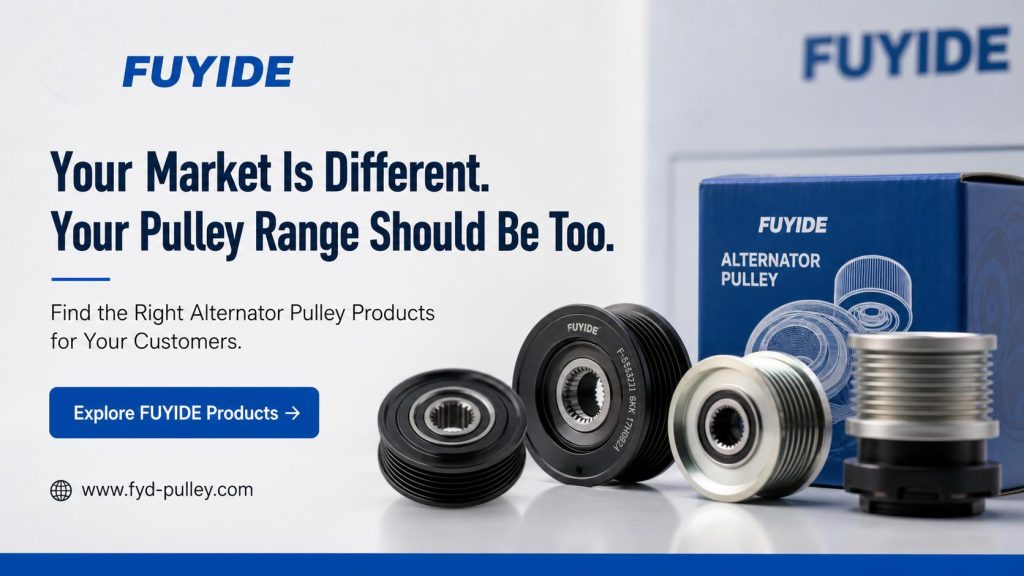
product availability and warehouse investment. (Illustrative image)
8. Why the Right Alternator Pulley Supplier Matters
Even a distributor with strong market knowledge may face difficulties building an effective pulley assortment without reliable supplier information.
An experienced Alternator Pulley Supplier can play an important role in supporting product selection.
Beyond manufacturing and supplying replacement components, useful supplier support may include product identification, application information, OE cross-reference data, and product range recommendations.
These resources can help distributors make more informed purchasing decisions.
What Should Distributors Look for in a Pulley Supplier?
When selecting an automotive aftermarket supplier, distributors should evaluate several factors.
Product range
Does the supplier offer pulley references covering relevant vehicle applications?
Product identification
Can the supplier provide clear product numbers, specifications, and available OE cross-references?
Technical information
Is sufficient information available to support accurate product matching?
Product consistency
Can the supplier maintain consistent product specifications and quality across repeat orders?
Purchasing flexibility
Can the supplier support purchasing quantities that suit the distributor’s market size and inventory strategy?
Long-term cooperation
Can the supplier communicate effectively as the distributor’s product requirements evolve?
A good supplier relationship should make it easier for distributors to maintain the right assortment over time.
9. How FUYIDE Can Support Distributors in Building a Market-Focused Pulley Product Range
For an automotive parts distributor, selecting a pulley supplier is not simply a matter of comparing unit prices.
The distributor also needs to understand which products are appropriate for its target market.
FUYIDE, an automotive pulley supplier, recognizes the importance of matching replacement parts with specific vehicle applications and aftermarket requirements.
Rather than treating every market as identical, a market-focused product selection process starts with understanding the distributor’s actual needs.
Step 1: Understand the Distributor’s Target Market
The first step is identifying the countries or regions where the distributor operates.
For example:
A distributor serving Germany may prioritize a different mix of European vehicle applications than a distributor operating in France, Poland, or Spain.
Even within the same country, local vehicle populations may vary.
Step 2: Identify Relevant Vehicle Applications
The distributor can provide information about its most common vehicle brands, models, and engine applications.
This information helps establish the initial product selection scope.
Step 3: Match Applications with Available Pulley References
Using verified product specifications and OE reference information, the distributor and supplier can identify appropriate alternator pulley references.
All compatibility information should be checked against the relevant application data before purchasing.
Step 4: Develop a Practical SKU Selection List
Instead of selecting products randomly from a large catalog, distributors can organize a shortlist based on:
High-priority vehicle applications
Verified pulley references
Expected market demand
Existing inventory
Purchasing budget
Replenishment requirements
The result is a more structured purchasing plan.
Step 5: Review and Adjust the Product Mix
After the initial purchasing period, distributors can compare actual sales with their original demand estimates.
Fast-moving products can receive greater inventory priority.
Slow-moving products can be reviewed.
New vehicle applications can be added as local market demand develops.
This ongoing process helps distributors refine their pulley product range.
From Product Supply to Better Product Selection
For distributors, the most valuable supplier relationship is one that combines dependable products with useful product information.
FUYIDE’s market positioning can emphasize this principle:
The right pulley product range starts with understanding the vehicles in your market.
By using vehicle application information, OE references, and local demand data, distributors can make better decisions about which pulley SKUs to purchase.
For specific product availability, technical information, and possible product selection assistance, distributors can contact the FUYIDE team directly.
Website: https://fyd-pulley.com/
10. Example: Building a Starter Pulley Inventory for a European Distributor
To understand how this strategy works in practice, consider a hypothetical automotive parts distributor serving a European town with approximately 80,000 residents.
The distributor supplies independent repair garages within the town and surrounding area.
Its customers regularly service Volkswagen, Audi, Renault, Peugeot, Ford, and several other vehicle brands.
The distributor wants to expand its alternator pulley business but has a limited initial purchasing budget.
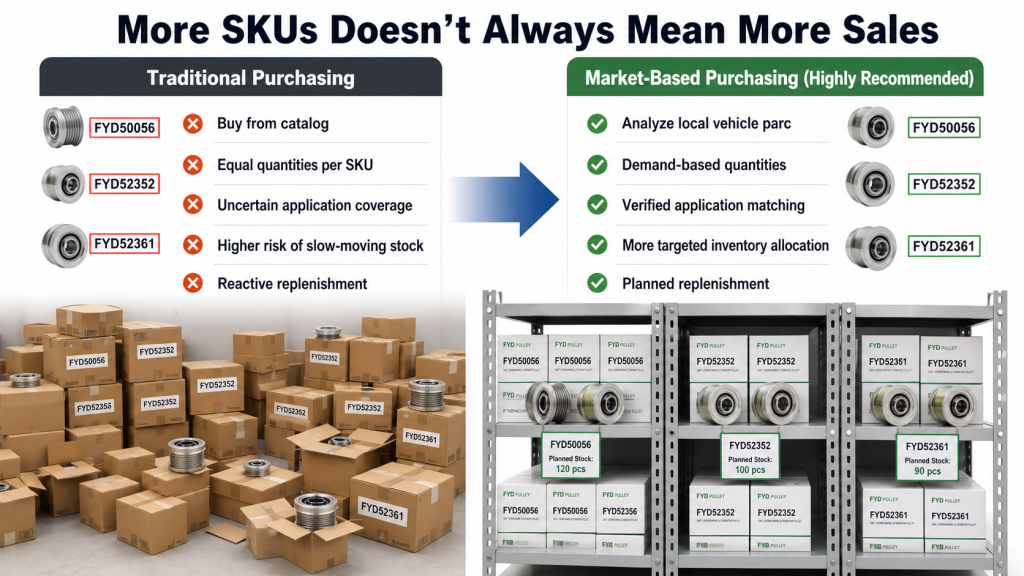
Traditional Purchasing Approach
The distributor requests a supplier catalog and selects 50 pulley SKUs.
It purchases 20 units of each SKU.
Total initial inventory:
50 SKUs × 20 units = 1,000 pulleys.
However, the distributor has not verified whether these references match local demand.
After several months, some SKUs sell quickly while others remain largely untouched.
The distributor experiences both stockouts and excess inventory.
Market-Based Purchasing Approach
Instead, the distributor studies local vehicle applications and workshop demand.
It identifies 50 pulley SKUs worth including in its initial assortment.
However, it divides them into different demand categories.
| Category | Number of SKUs | Units per SKU | Total Units |
| High-demand | 15 | 30 | 450 |
| Medium-demand | 20 | 10 | 200 |
| Low-demand | 15 | 3 | 45 |
| Total | 50 | — | 695 |
The distributor now purchases 695 pulleys instead of 1,000.
This represents a 30.5% reduction in initial unit inventory.
The actual financial savings would depend on the individual pulley prices.
Importantly, this example does not guarantee better sales or lower stockout rates. Those outcomes depend on the accuracy of demand estimates and replenishment planning.
However, it demonstrates the potential advantage of allocating inventory based on expected demand rather than purchasing equal quantities of every product.
The distributor can use the remaining budget to support replenishment or expand coverage when actual customer demand becomes clearer.
The Bigger Lesson
For a small or medium-sized automotive parts distributor, inventory efficiency can be just as important as product availability.
The most effective product assortment is not necessarily the one with the largest number of pulleys.
It is the one that provides suitable coverage of the local vehicle market while keeping inventory investment under control.
11. A Practical Checklist Before Placing Your Next Pulley Order
Before placing a wholesale alternator pulley order, distributors should review several important questions.
| Key Question | Why It Matters |
| Which vehicle models are most common in my market? | Identifies potential demand |
| Which engine variants are most relevant? | Improves application accuracy |
| Have the OE references been verified? | Reduces incorrect product matching |
| Which pulley SKUs cover multiple relevant applications? | Helps improve assortment efficiency |
| Which SKUs have the strongest sales potential? | Supports purchasing prioritization |
| How many units should I purchase? | Controls inventory investment |
| What is the supplier’s replenishment lead time? | Supports stock planning |
| How often should I review SKU performance? | Helps maintain inventory efficiency |
By answering these questions, distributors can transform pulley purchasing from a catalog-based process into a structured inventory strategy.
Conclusion: The Best Pulley Product Range Is Built Around Your Market
Building a successful alternator pulley business requires more than choosing products from a catalog.
For automotive parts distributors, the process should begin with understanding the vehicles that actually operate in their local market.
A practical approach follows a clear sequence:
Local Vehicle Parc → Vehicle Models → Production Years → Engine Applications → OE Numbers → Pulley Matching → SKU Selection → Purchasing Quantities → Inventory Planning
Each step helps improve the quality of the final purchasing decision.
For distributors operating in competitive automotive aftermarket markets, this approach can create meaningful operational advantages.
It can help improve application coverage, reduce unnecessary stock, and support more efficient inventory management.
At FUYIDE, the opportunity is to build supplier relationships around a simple idea:
Don’t just buy more pulleys. Build the right pulley range for your market.
Looking for an Alternator Pulley Supplier?
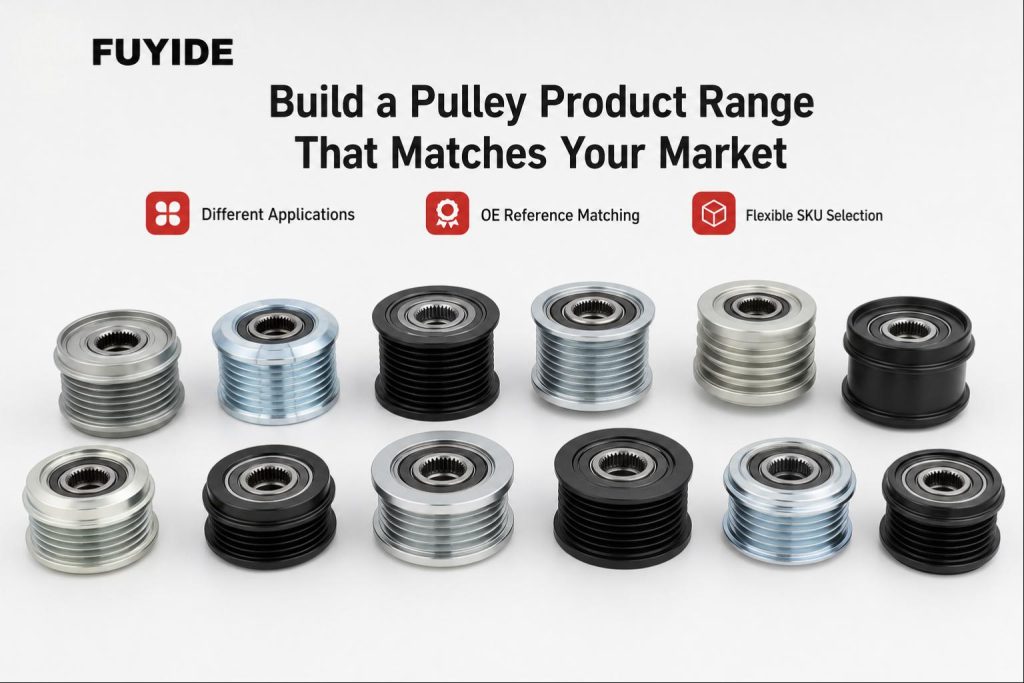
Whether you are an automotive parts importer, wholesaler, or regional distributor, selecting the right pulley references is an important part of building a competitive aftermarket business.
Explore FUYIDE’s automotive pulley products and contact the team to discuss your target vehicle applications, OE reference requirements, and product purchasing needs.
Visit FUYIDE: https://fyd-pulley.com/
Find the right pulley products for the vehicles your customers actually drive.
Related Products
Frequently Asked Questions
How should automotive parts distributors choose the right pulley SKU mix?
Distributors should analyze local vehicle parc data, popular vehicle models, repair demand, OE cross-reference numbers, and sales history. Prioritize fast-moving pulley SKUs first, then expand coverage based on customer requests and regional vehicle applications. Include compatible OAP and OAD models where local demand supports them.
Which automotive pulley types should an aftermarket distributor stock?
A distributor's inventory may include overrunning alternator pulleys (OAPs), overrunning alternator decouplers (OADs), and other application-specific automotive pulleys. The right selection depends on vehicle compatibility, replacement demand, target customers, and the existing product range. Always verify OE references and technical specifications before purchasing.
How can distributors reduce slow-moving automotive pulley inventory?
Use historical sales data, vehicle application coverage, customer inquiries, and supplier lead times to forecast demand. Start with proven high-demand SKUs, review inventory turnover regularly, and introduce new part numbers in stages. Flexible replenishment and reliable supplier support can help reduce excess stock and improve inventory efficiency.
What should distributors look for when sourcing automotive pulleys from a manufacturer?
Evaluate product quality, OE cross-reference accuracy, vehicle application coverage, manufacturing consistency, minimum order quantities, lead times, and export experience. Ask for technical specifications and quality documentation where available. A manufacturer that can support repeat orders and help identify suitable pulley models can be a valuable long-term sourcing partner.