


Quick answer
OEM automotive pulley manufacturing produces pulleys according to customer-provided drawings, specifications, or approved designs, while ODM manufacturing involves greater supplier participation in product design and development. FUYIDE supports custom automotive pulley inquiries, including alternator pulleys and crankshaft pulleys, with project-based technical review, sampling, and production planning. MOQ and lead time depend on product specifications, tooling, order quantity, and project requirements.
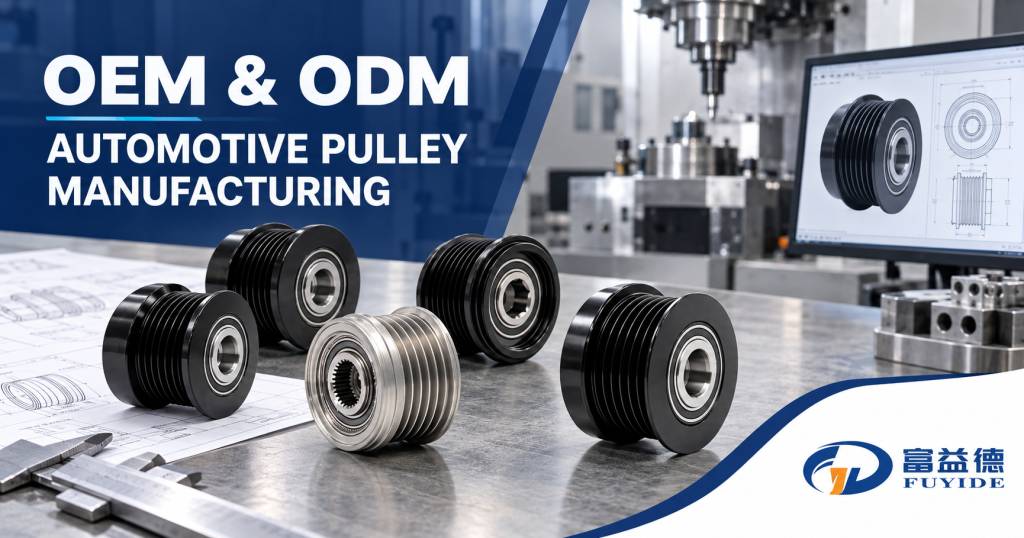
For automotive aftermarket brands, distributors, and equipment manufacturers, finding the right pulley supplier involves more than comparing product catalogs and unit prices.
Different markets and vehicle applications may require specific pulley dimensions, materials, functional designs, or packaging solutions. Standard products do not always meet these requirements.
This is where OEM and ODM automotive pulley manufacturing becomes important.
Working with an experienced manufacturing partner allows buyers to develop customized automotive pulley products, manufacture parts according to technical drawings, and establish a more flexible supply chain.
Whether you are sourcing a custom alternator pulley, developing a custom crankshaft pulley, or expanding your private label product range, understanding the OEM and ODM manufacturing process can help you make better purchasing decisions.
In this guide, we explain the differences between OEM and ODM manufacturing, the customization options available, and how FUYIDE supports automotive pulley development from initial requirements to production.
1. What Is OEM Automotive Pulley Manufacturing?
OEM stands for Original Equipment Manufacturer, although the term can have different meanings depending on the automotive supply chain.
In custom manufacturing discussions, OEM production generally refers to manufacturing products according to specifications, drawings, or requirements supplied by the customer.
For automotive pulleys, this may involve manufacturing parts based on an existing technical design or reproducing a component according to approved specifications.
How OEM Pulley Manufacturing Works
In a typical OEM manufacturing project, the customer provides technical information such as:
2D engineering drawings
3D CAD models
Product dimensions and tolerances
Material specifications
Surface treatment requirements
Functional performance requirements
Expected order quantities
The manufacturer reviews the technical information and evaluates production feasibility.
Once the specifications and commercial terms are confirmed, the project can proceed to sampling and production.
When Should Buyers Choose OEM Manufacturing?
OEM manufacturing may be suitable when buyers already have a completed product design.
For example, an automotive aftermarket distributor may need to manufacture a pulley according to an existing approved drawing.
An equipment manufacturer may require a specific pulley dimension for a particular accessory drive system.
In these situations, drawing-based manufacturing helps ensure that the final product follows the agreed technical specifications.
At FUYIDE, OEM projects can begin with customer drawings and clearly defined product requirements.
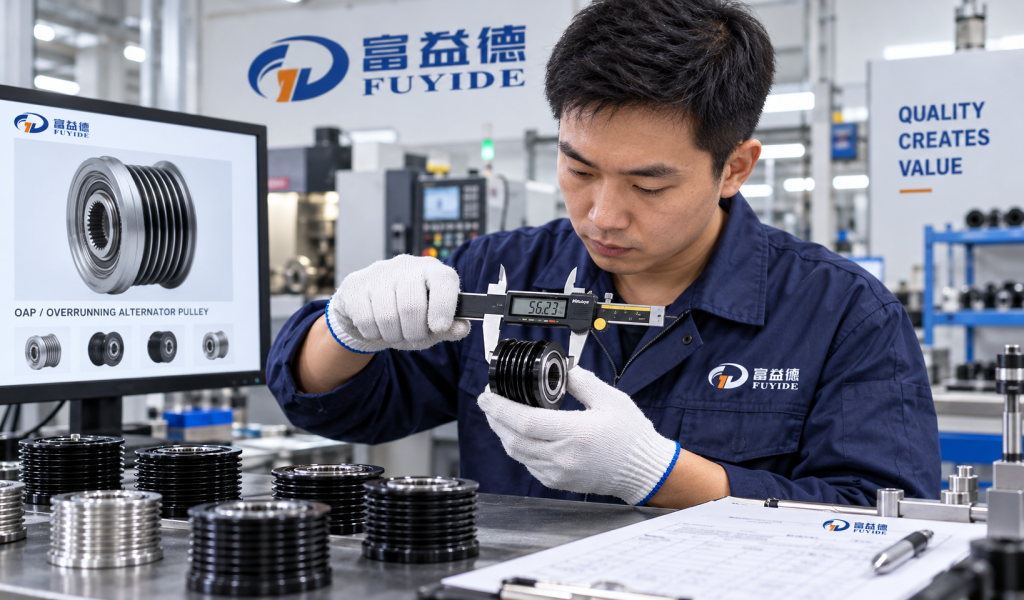
Suggested Image 1: OEM Automotive Pulley Manufacturing
Image description: A realistic automotive pulley placed beside a technical engineering drawing and precision measuring equipment.
Alt Text: OEM alternator pulley manufacturing based on customer drawings and technical specifications.
2.What Is ODM Automotive Pulley Manufacturing?
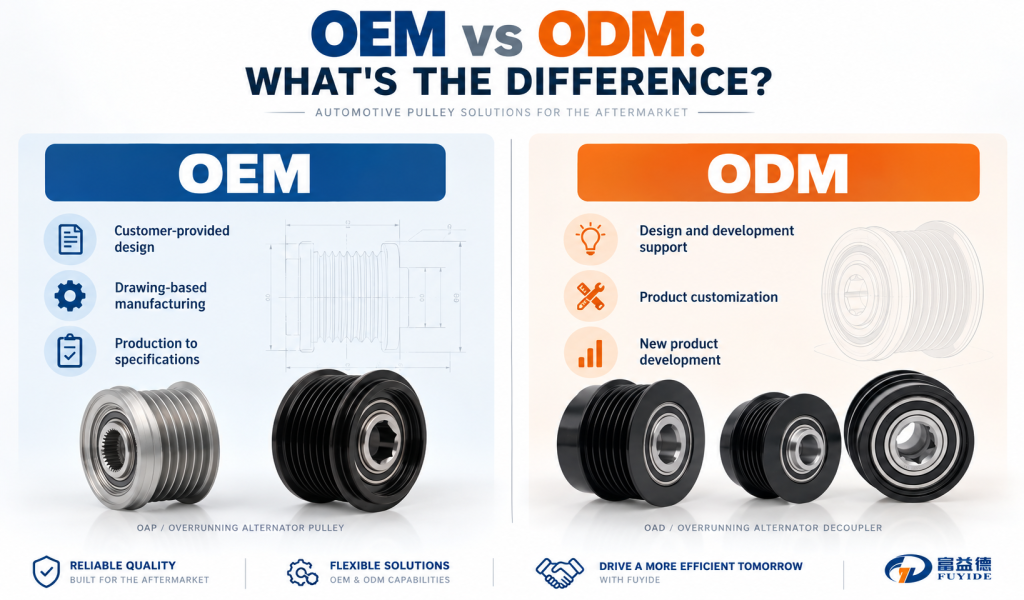
ODM stands for Original Design Manufacturer.
Unlike OEM manufacturing, where the customer typically provides an established design, ODM projects involve design or development work by the manufacturing partner.
The customer may begin with a product concept, functional requirements, or an existing component that needs modification.
The manufacturer then participates in developing a suitable product design.
How ODM Differs from OEM
The main difference is the level of design involvement.
| Feature | OEM Manufacturing | ODM Manufacturing |
| Initial Design | Usually supplied by buyer | Developed or adapted with manufacturer |
| Technical Drawings | Buyer-provided | May be developed during project |
| Product Customization | Based on specified requirements | May include new design development |
| Development Work | Often limited | Usually more extensive |
| Sampling | According to approved specifications | After design confirmation |
| Suitable Buyers | Buyers with established designs | Buyers requiring product development |
When Is ODM Manufacturing Useful?
ODM manufacturing can be useful when a buyer wants to develop a product but does not have complete engineering drawings.
For example, a customer may require a pulley with a modified mounting interface or a different structural configuration for a specific application.
The project may involve reviewing an existing sample, confirming dimensional requirements, and developing a manufacturable design.
ODM development can also support aftermarket brands seeking differentiated products.
However, design validation is particularly important for automotive components that operate under dynamic mechanical loads.
FUYIDE can discuss ODM and non-standard pulley development requirements based on the technical information provided by customers.
3.What Types of Automotive Pulleys Can Be Customized?
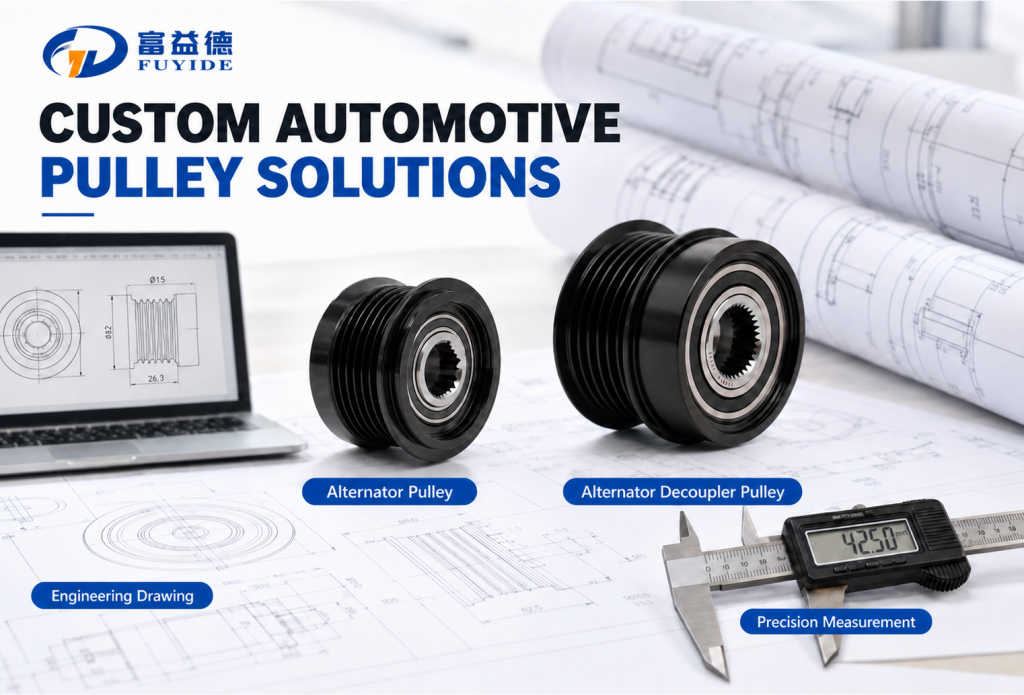
Automotive pulley customization may involve dimensional changes, material selection, mounting configurations, or functional requirements.
Different pulley types require different levels of engineering evaluation.
Custom Alternator Pulley
A custom alternator pulley may be required when an existing standard product does not match a specific alternator or engine application.
Depending on the product design, customization requirements may include:
Pulley diameter
Groove profile
Number of grooves
Mounting dimensions
Pulley offset
Surface treatment
Product identification
Functional specifications
For overrunning alternator pulleys, internal clutch performance and operating characteristics must also be considered.
A custom alternator pulley should be validated for its intended application before production approval.
Custom Crankshaft Pulley
A custom crankshaft pulley may require specific dimensions, belt groove arrangements, mounting interfaces, and material specifications.
Some crankshaft pulley designs also incorporate torsional vibration damping functions.
These components require appropriate engineering evaluation because their operating characteristics can affect engine accessory drive performance.
For buyers seeking a custom crankshaft pulley, it is important to clarify whether the requirement involves a simple pulley or a vibration-damping pulley assembly.
Manufacturing feasibility and validation requirements may differ significantly between these designs.
Non-Standard Automotive Pulleys
Not every automotive pulley requirement can be met by an existing catalog product.
Non-standard pulley development may involve:
Special dimensions
Modified groove configurations
Customized mounting interfaces
Application-specific designs
New product references
Customer-defined technical requirements
The feasibility of each project depends on its design complexity, materials, tooling requirements, and expected order volume.
Suggested Image 2: Custom Automotive Pulley Applications
Image description: A professional product layout showing different automotive pulley configurations, including alternator pulleys, crankshaft pulleys, and custom-machined pulley components.
Alt Text: Custom alternator pulley and custom crankshaft pulley manufacturing options for automotive applications.
4.Drawing-Based Manufacturing: From Design to Production
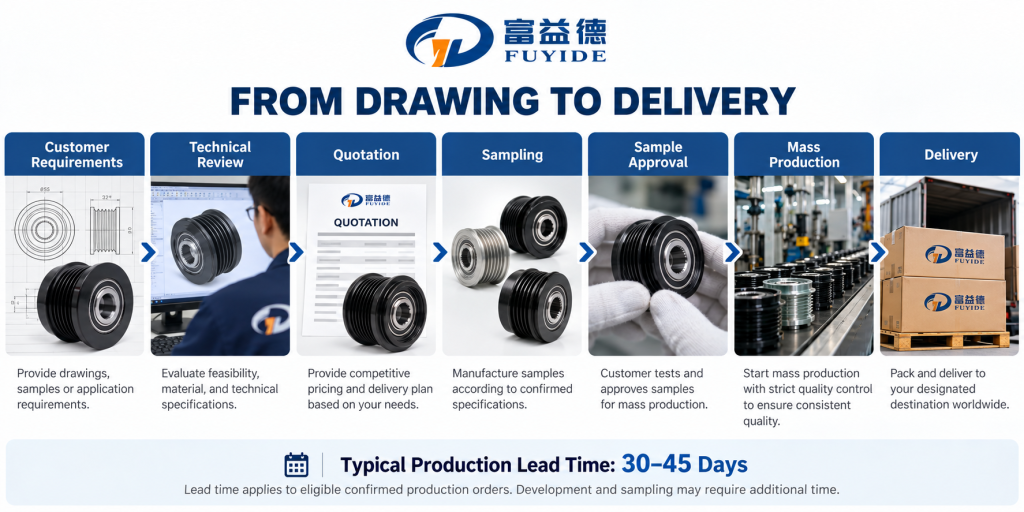
For international buyers, clear technical documentation is essential for successful custom manufacturing.
FUYIDE supports drawing-based manufacturing projects, allowing customers to submit technical information for production feasibility evaluation.
Step 1: Submit Your Drawings or Samples
Customers can provide available technical information, including:
2D drawings
3D files
Physical samples
OEM reference numbers
Material requirements
Product application details
Estimated purchasing quantities
The more complete the information, the easier it is to evaluate the project.
Step 2: Technical Review
Before production, the manufacturer needs to evaluate whether the proposed design can be manufactured.
Important factors may include:
Dimensional tolerances
Material suitability
Machining requirements
Assembly complexity
Surface finishing
Functional testing requirements
If technical information is incomplete, additional clarification may be necessary.
Step 3: Quotation and Project Confirmation
After reviewing the product requirements, the supplier can prepare a quotation based on the agreed specifications.
Pricing may depend on material costs, manufacturing complexity, tooling, order quantity, and packaging requirements.
Step 4: Sample Manufacturing
Sampling allows buyers to evaluate the proposed product before committing to bulk production.
Depending on the project, sample evaluation may include dimensional inspection, assembly checks, and relevant functional testing.
Step 5: Sample Approval
The customer reviews the samples and confirms whether they meet the agreed requirements.
If modifications are needed, the specifications should be updated before mass production.
Step 6: Mass Production
After sample approval and confirmation of the production order, the project moves into bulk manufacturing.
The production process should follow the approved drawings, specifications, and inspection requirements.
Step 7: Inspection and Delivery
Before shipment, products should be checked according to the agreed quality requirements.
Packaging, labeling, and delivery arrangements are then completed based on the purchase agreement.
Suggested Image 3: FUYIDE OEM & ODM Manufacturing Process
Image description: A seven-step flowchart showing Drawing Submission → Technical Review → Quotation → Sampling → Sample Approval → Mass Production → Delivery.
Alt Text: FUYIDE OEM and ODM automotive pulley manufacturing process from customer drawings to bulk delivery.
5. What Is the MOQ for Custom Automotive Pulleys?
Minimum Order Quantity, commonly known as MOQ, is an important consideration for automotive aftermarket buyers.
MOQ refers to the minimum quantity a manufacturer requires for a production order.
For custom automotive pulleys, MOQ is not always the same as the minimum order quantity for standard catalog products.
What Determines MOQ?
Several factors influence MOQ requirements.
Product Complexity
Complex pulley designs may require additional machining operations, special components, or assembly processes.
Tooling Requirements
Some customized products require dedicated tooling or fixtures.
The cost of these tools may influence the minimum economical production quantity.
Material Procurement
Special materials or components may have minimum purchasing quantities.
Manufacturing Efficiency
Production setup time and equipment utilization can affect the economic feasibility of small orders.
Customization Requirements
Custom packaging, surface treatment, or product identification may also influence MOQ.
Does FUYIDE Offer Flexible MOQ?
FUYIDE can discuss MOQ requirements according to the specific product and project.
For standard products and customized components, the appropriate minimum order quantity may differ.
Buyers are encouraged to provide their target quantity during the initial inquiry so that production feasibility and pricing can be evaluated.
Important: No fixed MOQ is stated here because actual requirements depend on the product specifications and commercial agreement.
6. Why Sampling Matters Before Bulk Production
Sampling is a critical stage in OEM and ODM automotive pulley manufacturing.
For buyers developing a new product, samples help confirm whether the design meets the intended requirements.
Dimensional Verification
The sample should be checked against the approved engineering drawings.
Important dimensions may include pulley diameter, groove geometry, mounting dimensions, and other specified tolerances.
Material and Surface Requirements
Buyers should verify that the sample meets the agreed material and surface treatment specifications.
These characteristics can influence product durability and corrosion resistance.
Functional Evaluation
Functional testing requirements depend on the product design.
For example, overrunning alternator pulleys may require verification of clutch behavior and other specified performance characteristics.
Crankshaft pulley assemblies may require additional evaluation based on their intended function.
Application Validation
A sample that meets dimensional requirements may still require validation in the intended automotive system.
Therefore, buyers should not treat dimensional inspection alone as proof of complete application suitability.
Sample Approval
After the sample has been evaluated and accepted, the approved specifications provide a reference for subsequent production.
This process helps reduce the risk of misunderstandings during bulk manufacturing.
7. How Long Does OEM & ODM Pulley Manufacturing Take?
Lead time is an important consideration when sourcing automotive components from overseas manufacturers.
Buyers need reliable delivery planning to manage inventory, product launches, and customer orders.
FUYIDE’s Typical Production Lead Time
For applicable orders, FUYIDE’s typical production lead time is approximately 30–45 days after the required specifications, order details, and production arrangements have been confirmed.
Actual lead times may vary depending on:
Product complexity
Material availability
Tooling requirements
Order quantity
Production schedule
Inspection requirements
Packaging specifications
For new ODM development projects, design work, tooling preparation, and sample approval may require additional time before bulk production begins.
Therefore, the 30–45-day period should not automatically be interpreted as the total time required for every new custom development project.
How Buyers Can Avoid Production Delays
Clear communication during the early stages of a project helps improve scheduling accuracy.
Buyers should provide complete drawings, confirm specifications promptly, and clarify inspection and packaging requirements before production.
When a project involves new tooling or design changes, these requirements should be discussed during quotation.
8. OEM & ODM Manufacturing for Automotive Aftermarket Brands
OEM and ODM manufacturing can help automotive aftermarket companies develop products that match their commercial requirements.
Different buyer groups may benefit from customized manufacturing in different ways.
Automotive Parts Distributors
Distributors may need specific product references to serve local vehicle applications.
Custom manufacturing can help address product requirements that are not covered by standard catalogs.
Private Label Brands
Aftermarket brands may require products manufactured according to their specifications, with agreed product identification or packaging arrangements.
Private label requirements should be confirmed during quotation, including labeling details and minimum order quantities.
Importers and Wholesalers
Importers may require consistent specifications across repeat orders.
Drawing-based production and sample approval can support clearer purchasing agreements.
Equipment Manufacturers
Equipment manufacturers may require pulley components designed for particular mechanical systems.
These projects often involve more detailed technical requirements and application validation.
9. What Should Buyers Prepare Before Requesting a Quotation?
Providing accurate technical information helps manufacturers evaluate custom automotive pulley projects efficiently.
Before contacting an OEM alternator pulley manufacturer, buyers should prepare the following information whenever available.
| Information | Why It Matters |
| Product Type | Identifies the required pulley category |
| 2D/3D Drawings | Defines dimensions and design requirements |
| Physical Sample | Supports technical evaluation |
| Material Requirements | Helps determine manufacturing feasibility |
| Surface Treatment | Defines finishing requirements |
| Functional Specifications | Clarifies expected performance |
| Order Quantity | Supports MOQ and pricing evaluation |
| Packaging Requirements | Influences quotation and delivery preparation |
| Destination Country | Supports export and logistics planning |
| Required Delivery Date | Helps evaluate production scheduling |
For projects involving existing automotive applications, OEM references and alternator part numbers may also be useful.
Clear technical requirements reduce the risk of quotation errors and unnecessary development delays.
10.Why Work with FUYIDE for Custom Automotive Pulley
Manufacturing?
Choosing the right manufacturing partner is important for automotive aftermarket buyers seeking customized pulley products.
FUYIDE focuses on automotive pulley products and provides OEM and ODM cooperation options for customers with different sourcing requirements.
OEM Manufacturing Based on Customer Drawings
Customers can submit drawings, specifications, or samples for technical evaluation.
This supports projects where the buyer already has a defined product design.
ODM and Non-Standard Product Development
For customers requiring modifications or new designs, FUYIDE can discuss ODM development and non-standard pulley requirements.
Project feasibility depends on the specific technical and production requirements.
Custom Automotive Pulley Projects
FUYIDE welcomes inquiries involving custom alternator pulleys and other automotive pulley components.
Custom crankshaft pulley requirements can also be submitted for technical feasibility review.
Sampling Before Bulk Production
Sample development and evaluation can be arranged according to the project requirements, helping buyers confirm specifications before production.
Project-Based MOQ
Minimum order quantities can be discussed based on the product type, customization requirements, and expected order volume.
Typical 30–45 Day Production Lead Time
For applicable confirmed orders, the typical production lead time is approximately 30–45 days.
New product development, tooling, or sampling may require additional time.
Frequently Asked Questions
What is the difference between OEM and ODM automotive pulley manufacturing?
OEM manufacturing generally involves producing parts according to customer-provided designs or specifications.
ODM manufacturing involves greater participation by the manufacturer in product design or development.
Can FUYIDE manufacture automotive pulleys according to customer drawings?
FUYIDE accepts drawing-based manufacturing inquiries. Customers can submit 2D drawings, 3D models, or samples for technical feasibility evaluation.
Can I order a custom alternator pulley?
Yes, custom alternator pulley requirements can be submitted for evaluation. Manufacturing feasibility depends on the design, materials, specifications, and order requirements.
Does FUYIDE support custom crankshaft pulley projects?
Customers can submit custom crankshaft pulley requirements for technical review. Feasibility depends on the specific design and manufacturing requirements.
What is the MOQ for OEM and ODM automotive pulleys?
MOQ depends on the product type, manufacturing complexity, materials, tooling, and order quantity. Contact FUYIDE with your specifications to discuss the applicable MOQ.
Does FUYIDE provide samples before mass production?
Sampling can be discussed as part of the OEM or ODM development process. The sample requirements, costs, and schedule depend on the project.
What is FUYIDE’s production lead time?
For applicable confirmed orders, the typical production lead time is approximately 30–45 days. New development projects may require additional time for design, tooling, and sample approval.
What information is needed for a custom pulley quotation?
Buyers should provide available drawings, samples, materials, dimensions, functional requirements, estimated quantities, and delivery expectations.
Start Your OEM & ODM Automotive Pulley Project with FUYIDE
Whether you need an OEM alternator pulley manufacturer, a custom alternator pulley, or technical support for a non-standard automotive pulley project, clear specifications and an organized development process are essential.
FUYIDE welcomes inquiries from automotive aftermarket distributors, importers, private label brands, and equipment manufacturers.
From drawing-based manufacturing and sample development to bulk production, FUYIDE can discuss solutions based on your technical and purchasing requirements.
Send us your drawings, samples, or OEM reference numbers to discuss your project.
Contact FUYIDE
Website: https://fyd-pulley.com/
Email: czfyd@fyd-cn.com
WhatsApp: +86 18915000258
Related Products
Frequently Asked Questions
What is the difference between OEM and ODM automotive pulley manufacturing?
OEM manufacturing generally produces automotive pulleys according to customer-provided drawings or specifications. ODM manufacturing involves greater supplier participation in product design or development. The suitable approach depends on whether the buyer already has an established design.
Can FUYIDE manufacture custom automotive pulleys from drawings?
FUYIDE accepts inquiries based on 2D drawings, 3D models, physical samples, or technical specifications. Each project is subject to manufacturing feasibility review and confirmation of the required dimensions, materials, tolerances, and functional specifications.
What is the MOQ for custom automotive pulleys?
The minimum order quantity depends on product complexity, materials, tooling, manufacturing setup, customization, and order volume. Buyers should provide the target quantity and technical requirements to obtain a project-specific quotation.
How long does OEM automotive pulley manufacturing take?
For applicable confirmed orders, FUYIDE lists a typical production lead time of approximately 30–45 days after specifications and production arrangements are confirmed. New product development, tooling, and sample approval may require additional time.