


Quick answer
To match an alternator pulley correctly, start with the original pulley OE number or a verified cross-reference number. Then confirm the alternator model, vehicle application, engine specifications, pulley type (OAP or OAD), and physical dimensions. Matching only the vehicle model or alternator number may be insufficient because different pulley designs can be used across similar applications.
Introduction: Why Finding the Right Alternator Pulley Can Be More Complicated Than Expected
For automotive parts distributors and repair workshops, identifying the correct alternator pulley is an essential part of replacement parts sourcing.
A customer may contact a distributor and ask:
“Do you have an alternator pulley for a Volkswagen Golf?”
At first, this sounds like a straightforward request.
However, Volkswagen Golf vehicles have been produced across multiple generations with different engine configurations and alternator specifications.
Even vehicles sharing the same model name may require different alternator pulley references.
This creates a common challenge for automotive aftermarket suppliers and distributors.
How can you identify the correct replacement pulley without relying on guesswork?
The answer is to combine several sources of information.
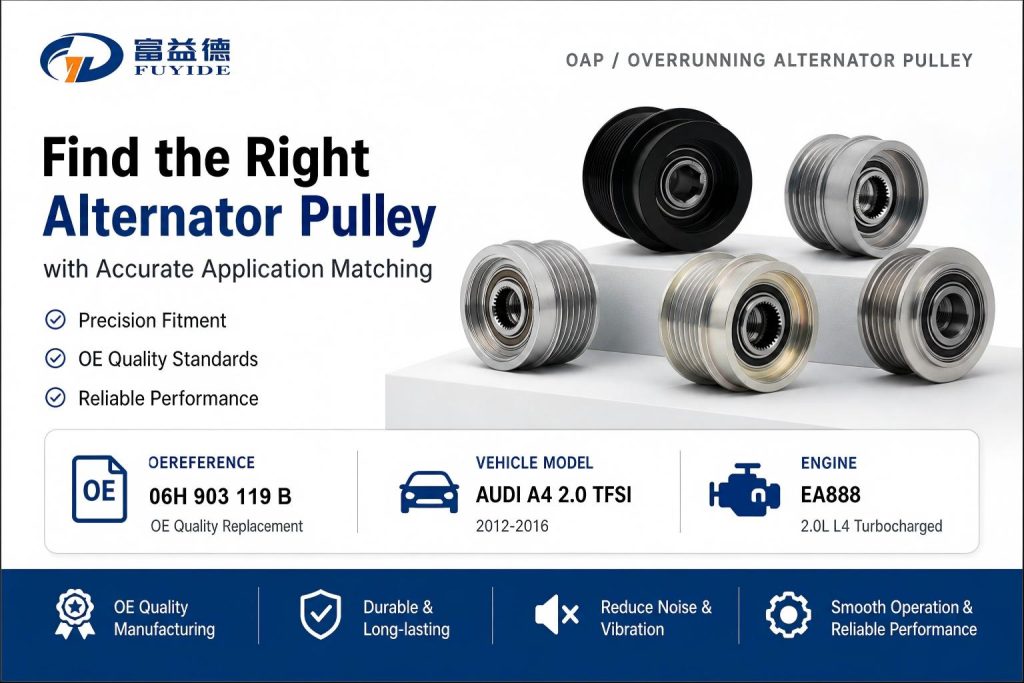
OE Number + Vehicle Model + Production Year + Engine Code + Alternator Specifications
Using these details together can improve product identification and reduce the risk of incorrect fitment.
In this guide, we explain how to match an Alternator Pulley by OE Number, verify vehicle applications, and identify the technical information needed before ordering.
1. Why Vehicle Model Alone Is Not Enough for Alternator Pulley Fitment
One of the most common mistakes in aftermarket parts sourcing is identifying replacement components using only the vehicle brand and model.
For example, a customer may request:
“Alternator pulley for BMW 320d.”
However, different BMW 320d production years and engine generations may use different alternator assemblies.
The same issue can occur across many vehicle brands.
Alternator pulley compatibility may depend on several factors:
Vehicle model
Production year
Engine code
Alternator manufacturer
Alternator part number
Original equipment reference
Therefore, Alternator Pulley Fitment should not be confirmed based on vehicle model information alone.
Example: One Vehicle Model, Multiple Possible Applications
Consider a hypothetical vehicle model produced over several years.
| Vehicle Information | Application A | Application B |
| Vehicle model | Same model | Same model |
| Production year | Earlier version | Later version |
| Engine | Engine variant A | Engine variant B |
| Alternator | Alternator type A | Alternator type B |
| Required pulley | Pulley reference A | Pulley reference B |
This example demonstrates why a distributor needs more than a vehicle name to identify the correct replacement.
Accurate matching requires application-level information.
2. Start with the OE Number Whenever Possible
An OE number is one of the most useful references for identifying replacement automotive components.
It helps connect the original component with potential aftermarket alternatives.
When a customer provides an OE number, the distributor can use a cross-reference catalog to identify relevant replacement pulley references.
How to Find an Alternator Pulley by OE Number
The basic process is:
Original OE Number → Cross-Reference Search → Potential Replacement Pulley → Technical Verification → Confirmed Product
However, OE matching should not be treated as a simple one-step confirmation.
A cross-reference database may identify possible replacement products, but the distributor should still verify compatibility.
Check the Complete OE Number
Small differences in OE references can indicate different products.
Therefore, distributors should use the complete part number rather than relying on partial numbers.
Check for Superseded OE Numbers
Vehicle manufacturers may replace older OE references with newer part numbers.
When this happens, distributors should verify whether the updated reference is compatible with the original application.
Verify the Alternator Assembly
Some alternator pulley applications are closely linked to the alternator manufacturer and assembly specification.
Therefore, the alternator part number can provide valuable additional identification information.
3. Check the Technical Specifications Before Confirming Fitment
Even when an OE cross-reference suggests a replacement product, technical verification remains important.
Two alternator pulleys may look similar but have different internal designs or dimensions.
Important specifications may include:
Pulley Type
Identify whether the application requires:
Overrunning Alternator Pulley (OAP)
Overrunning Alternator Decoupler (OAD)
Solid alternator pulley
Another specified pulley design
Different pulley mechanisms are not automatically interchangeable.
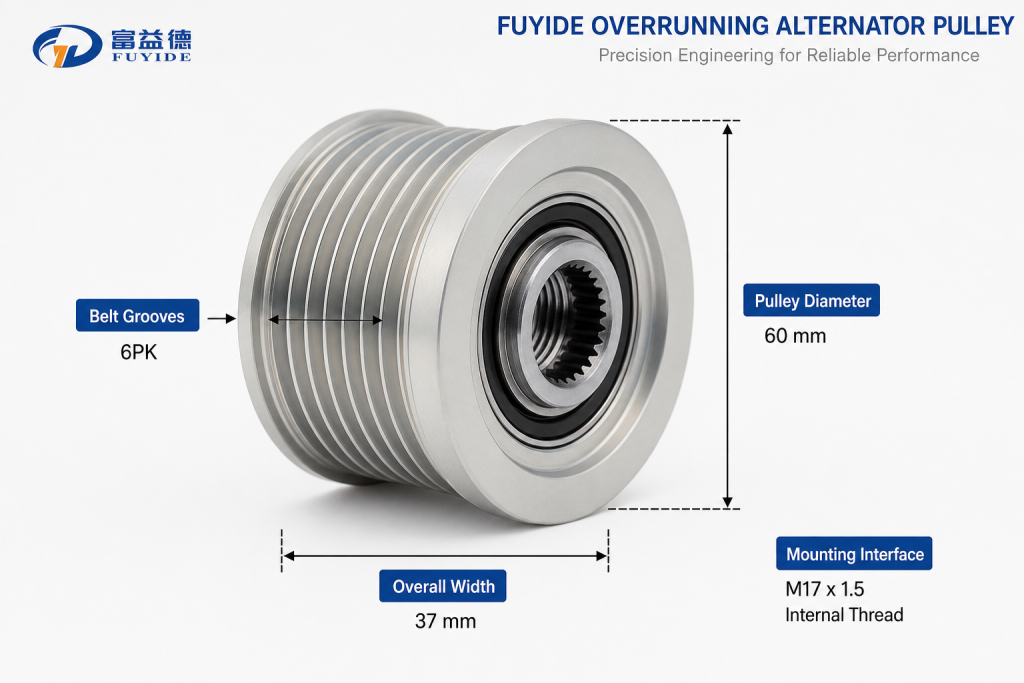
Pulley Diameter
The pulley diameter must match the technical requirements of the application.
Belt Groove Configuration
The number and profile of belt grooves must be compatible with the specified belt-drive system.
Mounting Interface
Verify the required mounting dimensions and connection design.
Overall Dimensions
Width, offset, and other installation dimensions may affect fitment.
Internal Mechanism
For OAP and OAD products, the internal mechanism must match the functional requirements of the original application.
A visually similar pulley is not necessarily a compatible replacement.
4. How to Match an Alternator Pulley When the OE Number Is Missing
Sometimes the original OE number is unavailable.
The number may be damaged, unreadable, or missing from the component.
In this situation, distributors should collect additional information.
Identify the Alternator Reference
The alternator manufacturer’s part number may help identify the original pulley application.
Collect Vehicle Information
Request the vehicle model, production year, engine variant, and other available application information.
Check the Original Pulley
Photographs and physical measurements can provide useful supporting information.
However, visual inspection alone should not be treated as sufficient proof of compatibility.
Consult a Reliable Product Catalog
Use verified application data to identify potential replacement references.
Ask the Supplier for Product Identification Assistance
If uncertainty remains, send the available technical information to the supplier for review.
For example:
A distributor can provide the alternator number, vehicle details, and photographs of the original pulley to FUYIDE.
The available information can then be reviewed against relevant product documentation.
5. Using the FUYIDE Product Catalog for Alternator Pulley Identification
For distributors sourcing aftermarket pulleys, a structured product catalog can make product identification easier.
FUYIDE provides an online product section where customers can explore available products.
FUYIDE Product Catalog:
When reviewing products, distributors should look for available information such as:
Product reference
OE cross-reference
Technical specifications
Pulley configuration
Vehicle or alternator application information
The exact information available may vary by product.
A Practical Product Identification Process
Step 1: Obtain the OE number or alternator reference.
Step 2: Search or review the relevant FUYIDE product information.
Step 3: Identify potential matching pulley references.
Step 4: Compare technical specifications and application information.
Step 5: Contact FUYIDE to confirm product availability and purchasing requirements.
FUYIDE Product Matching Table

6. Common Alternator Pulley Fitment Mistakes to Avoid
Mistake 1: Matching Only by Vehicle Brand
Not every pulley used by the same vehicle manufacturer is interchangeable.
Mistake 2: Ignoring Engine Variants
Different engine configurations may require different pulley specifications.
Mistake 3: Using Incomplete OE Numbers
Partial OE references can create identification errors.
Mistake 4: Assuming OAP and OAD Are Interchangeable
The two designs have different operating characteristics.
Mistake 5: Relying Only on Product Photographs
External appearance may not reveal important technical differences.
Mistake 6: Ignoring Alternator Specifications
The alternator assembly can be critical to correct pulley identification.
Avoiding these mistakes can reduce incorrect orders and improve aftermarket sourcing accuracy.
7. How Accurate Fitment Information Helps Distributors
Accurate application data provides several business advantages.
Fewer Incorrect Orders
Verified product matching can reduce the risk of purchasing unsuitable components.
Faster Customer Response
When distributors have reliable OE and application information, they can identify potential replacement products more efficiently.
Better Inventory Planning
Understanding which pulley references serve specific vehicle applications supports more structured SKU management.
Improved Supplier Communication
Providing OE numbers and alternator references makes purchasing inquiries easier to evaluate.
Greater Confidence in Product Selection
Accurate technical information helps distributors make better-informed purchasing decisions.
For automotive aftermarket businesses, these benefits contribute to more efficient daily operations.
8. What Information Should You Send to FUYIDE for Pulley Matching?
If you are unsure which alternator pulley is suitable for your application, prepare as much information as possible.
| Required Information | Purpose |
| OE Number | Initial replacement identification |
| Alternator Part Number | Alternator compatibility verification |
| Vehicle Make and Model | Application identification |
| Production Year | Application variation checking |
| Engine Code | Engine-specific matching |
| Original Pulley Photos | Supporting product identification |
| Required Quantity | Wholesale quotation preparation |
Not every inquiry will contain all these details.
However, complete information can make the matching process more efficient.
Conclusion: Accurate Alternator Pulley Matching Starts with the Right Information
Finding the correct alternator pulley requires more than identifying the vehicle model.
OE numbers, production years, engine codes, alternator references, and technical specifications all play important roles.
A reliable matching process follows this sequence:
OE Number → Vehicle Information → Engine Identification → Alternator Verification → Technical Comparison → Confirmed Pulley
For automotive parts distributors, accurate fitment information can reduce sourcing errors, improve inventory planning, and support better customer service.
When sourcing aftermarket alternator pulleys, use verified product information and confirm compatibility before placing an order.
Need Help Identifying an Alternator Pulley?
Are you looking for an alternator pulley by OE number, vehicle model, or engine application?
Explore the FUYIDE product catalog or contact the team with your available reference information.
FUYIDE Product Catalog:
https://fyd-pulley.com/products
Send Your OE Number or Alternator Reference →
Related Products
Frequently Asked Questions
What is the difference between a pulley OE number and an alternator part number?
A pulley OE number identifies a pulley component, while an alternator part number identifies an alternator assembly or configuration. These numbers serve different purposes and should be recorded separately when checking replacement compatibility.
Why is the engine code important when matching an alternator pulley?
The engine code helps identify the exact powertrain configuration. Different engines within the same vehicle model may use different alternators, belt drive arrangements, or pulley designs. Including the engine code helps narrow down the correct replacement.
Can two alternator pulleys with the same groove count be different?
Yes. Pulleys with the same number of grooves may have different diameters, offsets, mounting interfaces, operating mechanisms, or belt profiles. Groove count alone is not sufficient to confirm interchangeability.
What information should I provide when requesting an alternator pulley quotation?
Provide the original pulley OE number if available, alternator part number, vehicle make and model, production year, engine code, pulley photos, relevant dimensions, and required quantity. This information helps suppliers evaluate the correct replacement and prepare a more accurate quotation.