


Quick answer
OE number cross-referencing simplifies automotive aftermarket sourcing by helping buyers identify compatible replacement parts across different brands and manufacturers. It improves part identification, reduces ordering errors, and streamlines procurement. For automotive pulley sourcing, OE number cross-references help distributors and repair professionals find suitable replacement parts more efficiently.
Introduction: One of the Most Common Questions in Automotive Parts Sourcing
“Does this alternator pulley fit my customer’s vehicle?”
For automotive parts distributors, importers, and repair workshops, this is one of the most important questions when purchasing replacement components.
A distributor may receive a request for an alternator pulley used in a Volkswagen, Audi, BMW, Renault, or another vehicle.
However, identifying the correct replacement part is not always straightforward.
Even vehicles from the same manufacturer may use different alternator pulley specifications depending on their production year, engine configuration, and alternator assembly.
Two pulleys may look almost identical but have different technical requirements.
Selecting the wrong component can lead to incorrect orders, additional shipping costs, customer complaints, and delayed repairs.
This is where OE Number Cross Reference becomes valuable.
By connecting original equipment numbers with verified aftermarket product references, distributors can identify potential replacement parts more efficiently.
For businesses sourcing alternator pulleys, an accurate cross-reference process can reduce uncertainty and improve purchasing decisions.
In this guide, we explain how OE number cross-referencing works, why it matters for automotive aftermarket sourcing, and how distributors can use it when selecting alternator pulleys from suppliers such as FUYIDE.
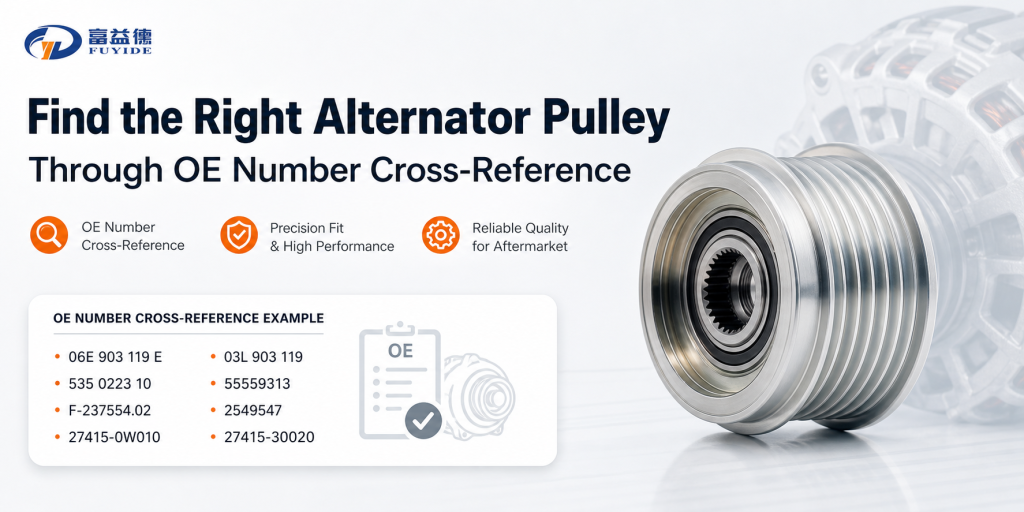
1. What Is an OE Number in Automotive Parts?
An OE number is a reference used to identify an original equipment component.
Vehicle manufacturers and original equipment suppliers use part numbers to identify components within their product systems.
For automotive aftermarket distributors, these numbers provide an important starting point for identifying replacement parts.
Why Are OE Numbers Important?
Imagine a customer contacts an automotive parts distributor and says:
“I need an alternator pulley for a Volkswagen Golf.”
This information may not be sufficient to identify the correct replacement part.
Different Golf generations and engine variants may use different alternator assemblies and pulley specifications.
A more precise inquiry might include:
Vehicle make and model
Production year
Engine code
Alternator manufacturer
Original equipment part number
With this information, the distributor can narrow down the possible replacement products.
OE Numbers vs. Aftermarket Part Numbers
OE numbers and aftermarket supplier part numbers serve related but different purposes.
An OE number identifies a component within an original equipment system.
An aftermarket part number identifies a replacement product offered by a particular supplier.
One aftermarket product may be associated with several OE references.
However, an OE cross-reference listing should not automatically be treated as proof of universal interchangeability.
Fitment must still be verified using technical specifications and relevant application information.
2. What Is OE Number Cross-Reference?
OE Number Cross Reference is the process of matching an original equipment part number with corresponding replacement part references.
In automotive aftermarket sourcing, this process helps distributors identify potential alternatives to original equipment components.
For example, a distributor may receive an OE number from a repair workshop.
Instead of searching through hundreds of product photographs, the distributor can use a cross-reference database to identify relevant aftermarket products.
The basic process is:
OE Number → Cross-Reference Database → Aftermarket Product Number → Technical Verification → Confirmed Replacement Part
This approach can make product identification more systematic.
How Automotive Parts Cross Reference Works
A typical automotive parts cross-reference process involves several steps.
Step 1: Identify the Original Part Number
Obtain the OE number from reliable vehicle documentation, the original component, or verified parts data.
Step 2: Search the Cross-Reference Database
Use the OE reference to locate potential aftermarket replacement products.
Step 3: Compare Technical Specifications
Verify the relevant dimensions, design, and alternator compatibility.
Step 4: Confirm Vehicle Applications
Check the vehicle model, production period, engine configuration, and alternator assembly.
Step 5: Select the Replacement Product
Only confirm the replacement part when the available information supports compatibility.
This process is especially important for alternator pulleys because similar-looking products are not always interchangeable.
3. Why Alternator Pulley Cross-Reference Requires Technical Verification
An alternator pulley is not simply a metal wheel attached to an alternator.
Depending on its design, it can perform important functions within the engine accessory drive system.
Many modern vehicles use specialized alternator pulley technologies.
These include:
Overrunning Alternator Pulley (OAP)
An OAP typically uses a one-way clutch mechanism that allows the alternator rotor to overrun under certain operating conditions.
Overrunning Alternator Decoupler (OAD)
An OAD incorporates a decoupling mechanism designed to help manage torsional vibrations within the accessory drive system.
Although both are used in alternator drive applications, their operating characteristics differ.
Therefore, distributors should not assume that an OAP and an OAD are interchangeable.
Why Visual Matching Is Not Enough
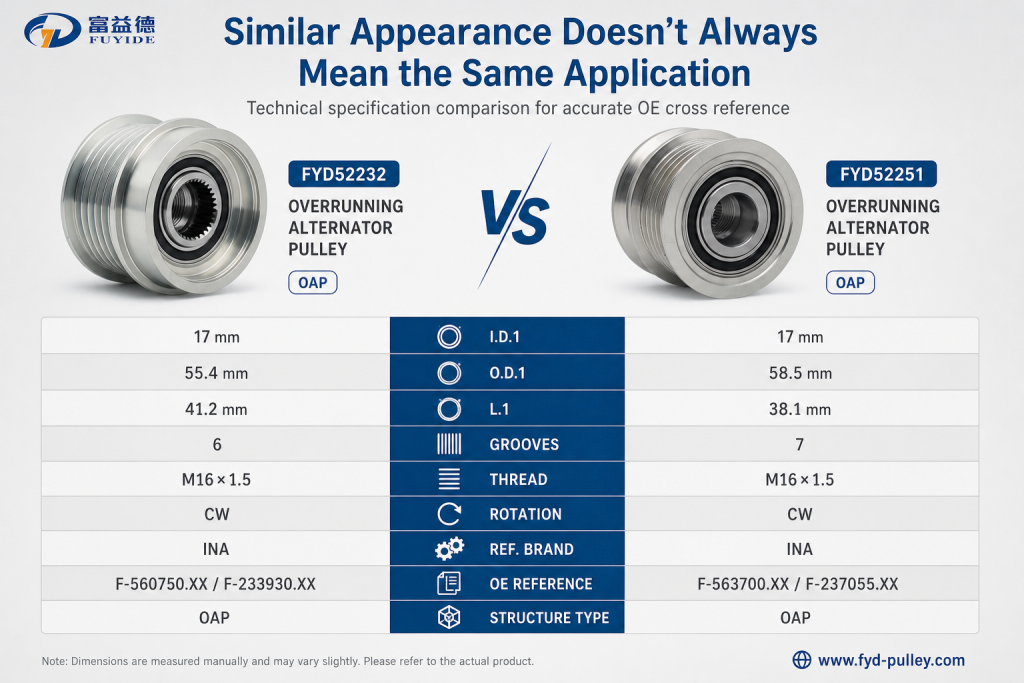
Two alternator pulleys may have similar external appearances but differ in:
Pulley diameter
Number of belt grooves
Overall dimensions
Thread specifications
Internal clutch mechanism
Alternator compatibility
These differences can affect installation and operation.
An incorrect pulley may create belt-drive problems or fail to perform the function required by the original application.
For this reason, Alternator Pulley Cross Reference should combine OE information with technical verification.
Example: Two Similar-Looking Pulley Products
Consider two hypothetical alternator pulley references.
| Technical Feature | Pulley A | Pulley B |
| Pulley type | OAP | OAD |
| External appearance | Similar | Similar |
| Internal mechanism | One-way clutch | Decoupling mechanism |
| Vehicle application | Application-specific | Application-specific |
| Interchangeability | Requires verification | Requires verification |
This example demonstrates why relying only on photographs can lead to incorrect product selection.
4. How OAP Cross Reference Helps Distributors Identify Replacement Pulleys
For distributors purchasing overrunning alternator pulleys, accurate product identification is essential.
An OAP Cross Reference connects an original equipment reference with a potentially compatible aftermarket overrunning alternator pulley.
However, OE matching should be supported by additional technical information.
Important Information for OAP Cross-Reference
When identifying an OAP replacement, distributors should consider the following.
Original Equipment Reference
The OE number provides the initial product identification reference.
Alternator Manufacturer
Different alternator manufacturers may use different pulley designs and specifications.
Pulley Dimensions
Diameter, width, and other critical dimensions must be checked.
Belt Groove Configuration
The pulley must match the required belt configuration.
Internal Mechanism
The replacement product must provide the functionality required by the original application.
Vehicle and Engine Application
Compatibility should be confirmed for the relevant vehicle and engine configuration.
Why OE Matching Alone May Not Be Sufficient
A cross-reference database is a useful identification tool.
However, errors or incomplete information can exist in product catalogs.
Some OE numbers may also have been superseded or replaced by later references.
Therefore, distributors should verify the current application information before confirming an order.
A reliable OAP cross-reference process combines product identification with technical validation.
5. How to Match OE Numbers with FUYIDE Alternator Pulley Products
For automotive parts distributors sourcing replacement pulleys, the most practical approach is to begin with a verified product reference.
FUYIDE’s product catalog can serve as a starting point for reviewing available alternator pulley products.
FUYIDE Product Catalog:
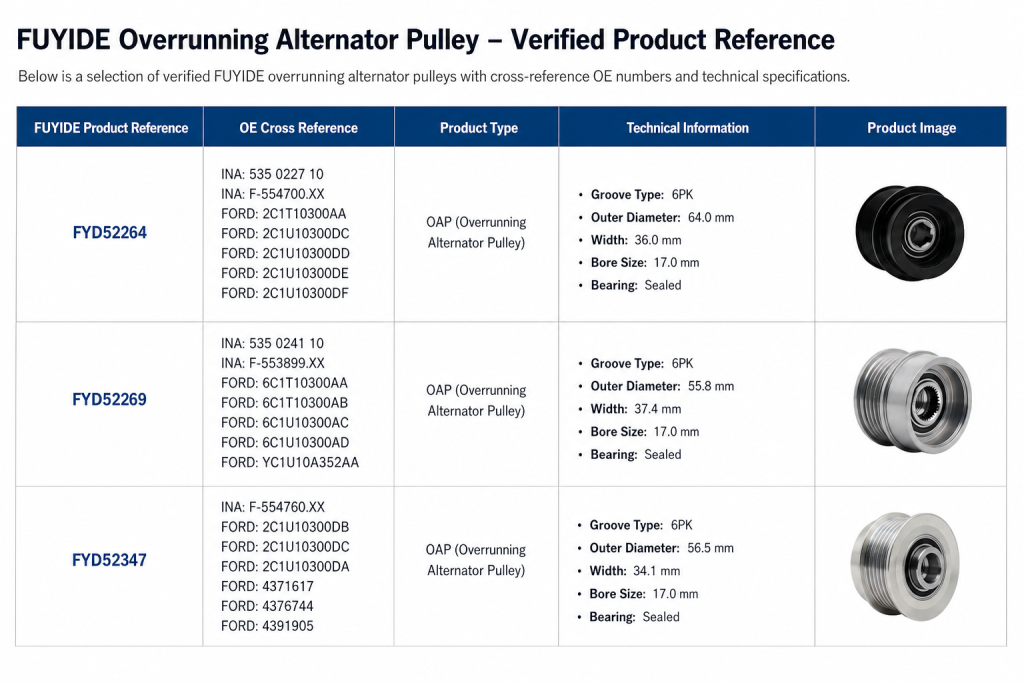
When reviewing a product, distributors should look for available information such as product identification numbers, OE references, technical specifications, and application details.
Step 1: Obtain the Customer’s OE Number
Ask the customer to provide the original equipment number whenever possible.
If the OE number is unavailable, request additional identification information.
This may include the alternator part number, vehicle details, or photographs showing the original pulley markings.
Step 2: Identify Potential FUYIDE Products
Review the FUYIDE product catalog or submit the available reference information to the FUYIDE team.
The goal is to identify products that may correspond to the requested application.
Step 3: Compare Technical Information
Before selecting a replacement pulley, compare the available technical specifications.
Important details may include the pulley type, dimensions, belt groove configuration, and alternator compatibility.
Step 4: Verify Application Compatibility
Where reliable application data is available, confirm compatibility with the relevant vehicle and engine.
Step 5: Confirm the Product Before Ordering
Once the product reference and technical requirements have been verified, the distributor can proceed with the purchasing inquiry.
This structured approach can reduce the risk of ordering an incorrect replacement part.
FUYIDE Product Cross-Reference Example
6. Common Mistakes in Automotive Parts Cross-Reference
OE cross-referencing can improve sourcing efficiency, but incorrect use of reference information may create problems.
Mistake 1: Matching Products Only by Vehicle Brand
A pulley designed for one Volkswagen application may not fit another Volkswagen vehicle.
Engine specifications and alternator configurations must be considered.
Mistake 2: Assuming Similar OE Numbers Mean Interchangeability
Part numbers that look similar are not necessarily interchangeable.
Even a small difference in the reference may indicate a different component.
Always verify the complete number.
Mistake 3: Ignoring Pulley Type
OAP and OAD products may have different operating characteristics.
Replacing one design with another without proper verification can create application problems.
Mistake 4: Relying Only on Product Photographs
Photographs can help identify external characteristics.
However, they may not reveal internal design differences or exact dimensions.
Mistake 5: Using Unverified Cross-Reference Data
Cross-reference information should come from reliable product documentation.
If multiple sources provide conflicting information, further verification is necessary.
For automotive parts distributors, preventing incorrect product matching is often more valuable than saving a few minutes during the initial product search.
7. How OE Cross-Reference Improves Automotive Aftermarket Sourcing Efficiency
For automotive parts importers and wholesalers, product identification affects more than technical accuracy.
It also influences purchasing efficiency, inventory management, and customer service.
Faster Product Identification
When a distributor receives an OE number, a reliable cross-reference system can help identify potential replacement products more quickly.
This reduces the need to search through large catalogs manually.
Fewer Incorrect Orders
Verifying OE references and technical specifications can reduce the risk of purchasing unsuitable products.
This may help lower the number of returns and replacement shipments.
Better SKU Management
Cross-reference information can help distributors understand which product references are associated with different vehicle applications.
This supports more structured inventory planning.
More Efficient Supplier Communication
Instead of sending only a vehicle model description, distributors can provide a specific OE number or alternator reference.
This makes purchasing inquiries easier to evaluate.
Improved Customer Service
Repair workshops often need replacement parts quickly.
Accurate identification can help distributors respond to customer requests with greater confidence.
For automotive aftermarket businesses, these advantages can contribute to more efficient daily operations.
8. From OE Cross-Reference to Better Pulley SKU Planning
OE cross-reference data is useful not only for identifying a single replacement component.
It can also support broader inventory planning.
Consider a distributor serving a regional European market.
The distributor regularly receives requests for alternator pulleys used in various Volkswagen, Audi, Renault, Peugeot, and Ford applications.
Instead of purchasing random pulley references, the distributor can organize its requirements using OE information.
The process may look like this:
Local Vehicle Applications
↓
Engine and Alternator Identification
↓
OE Number Collection
↓
Automotive Parts Cross Reference
↓
Verified Pulley Product Matching
↓
SKU Selection
↓
Purchasing Quantity Planning
This approach connects technical product identification with commercial inventory decisions.
Why This Matters for Distributors
A distributor may discover that one verified aftermarket pulley reference is associated with multiple relevant OE numbers.
Where the cross-reference and application data confirm interchangeability, this may help simplify inventory planning.
However, the distributor should not assume that all OE numbers listed together necessarily cover every vehicle application without additional verification.
Accurate application data remains essential.
Related Reading
For a more detailed explanation of inventory planning, see:
How Automotive Parts Distributors Can Build the Right Pulley SKU Mix for Their Local Market
This guide explains how distributors can use local vehicle populations, engine applications, OE information, and expected demand to build a practical pulley product range.
9. What Information Should Distributors Send When Requesting a Pulley Cross-Reference?
One of the easiest ways to improve supplier communication is to provide complete product identification information.
When contacting an alternator pulley supplier, distributors should prepare as much of the following information as possible.
| Information | Why It Matters |
| OE Number | Primary reference for identifying potential replacements |
| Alternator Part Number | Helps verify alternator compatibility |
| Vehicle Make and Model | Provides application context |
| Production Year | Helps distinguish application variations |
| Engine Code | Supports more precise fitment verification |
| Pulley Type | Helps distinguish OAP, OAD, and other designs |
| Original Product Photos | Supports physical identification |
| Required Quantity | Helps prepare a purchasing quotation |
Not every inquiry will include all these details.
However, providing more reliable information can make the identification process easier.
Example of a Product Inquiry
A distributor might contact FUYIDE with the following information:
“Hello, we are an automotive parts distributor in Germany.
We are looking for an alternator pulley replacement.
We have the original OE number and alternator reference.
Could you check whether you have a corresponding product and provide the technical specifications?”
This type of inquiry is more useful than simply asking:
“Do you have a pulley for Volkswagen?”
It gives the supplier a clearer starting point for product identification.
10. How FUYIDE Can Support OE-Based Pulley Sourcing Discussions
For automotive parts distributors, selecting a supplier involves more than finding a product with a similar appearance.
Reliable product identification is an important part of the purchasing process.
FUYIDE’s automotive pulley product range provides a starting point for customers seeking replacement pulley references.
Distributors can review the available products and contact FUYIDE with specific identification requirements.
Product Reference Identification
Customers can provide OE numbers, alternator references, or existing product identification information.
These details can be reviewed against available product documentation.
Technical Information Review
Where relevant specifications are available, distributors can compare product dimensions and other technical characteristics.
Product Availability Discussion
Once a potential replacement reference has been identified and compatibility has been verified, customers can inquire about product availability and purchasing conditions.
Support for Distributor Purchasing Lists
Distributors purchasing multiple pulley references can organize their requirements into an OE-based product list.
This provides a clearer basis for discussing product selection and wholesale purchasing.
The objective is to make communication more structured and reduce uncertainty during sourcing.
Accurate OE cross-reference information helps connect the customer’s original part requirement with a suitable aftermarket replacement product.
For specific product matching, distributors should contact FUYIDE with the relevant technical information.
Website: https://fyd-pulley.com/
11. Frequently Asked Questions About Alternator Pulley Cross-Reference
Can I identify an alternator pulley using only an OE number?
An OE number is a useful starting point.
However, final identification may require additional information such as the alternator model, pulley specifications, and vehicle application.
Can one aftermarket alternator pulley replace several OE numbers?
Yes, in some cases.
A single aftermarket reference may correspond to multiple verified OE numbers.
However, compatibility must be supported by reliable cross-reference and application data.
Are OAP and OAD pulleys interchangeable?
Not automatically.
OAP and OAD products have different operating characteristics.
The correct replacement should match the original application’s technical requirements.
Can I identify a pulley using only a vehicle model?
Vehicle model information alone may not be sufficient.
Production year, engine configuration, and alternator specifications may also be necessary.
What should I do if I cannot find my OE number in a supplier’s catalog?
Contact the supplier with the available OE number, alternator reference, vehicle information, and product photographs.
The supplier can review the information against its available product documentation.
Does an OE cross-reference guarantee fitment?
No.
OE cross-reference information is an identification aid.
Fitment should be confirmed using reliable technical specifications and application data.
Conclusion: Accurate OE Cross-Reference Makes Automotive Parts Sourcing Easier
For automotive parts distributors, identifying the correct replacement component is one of the most important parts of the purchasing process.
This is particularly true for alternator pulleys, where technical differences may not be obvious from external appearance.
An effective OE Number Cross Reference process helps connect original equipment information with potential aftermarket replacement products.
However, successful product matching requires more than comparing part numbers.
Distributors should also verify alternator specifications, pulley design, dimensions, and vehicle applications.
A reliable sourcing process follows a clear sequence:
OE Number → Cross-Reference Search → Product Identification → Technical Verification → Confirmed Replacement
By following this process, distributors can improve purchasing accuracy, reduce incorrect orders, and communicate more effectively with suppliers.
For automotive aftermarket businesses, accurate product identification is an essential part of building a dependable replacement parts supply chain.
Need Help Finding the Right Alternator Pulley?
Are you looking for an aftermarket alternator pulley replacement based on an OE number?
Do you need to identify a corresponding pulley reference for your customer’s vehicle or alternator?
Contact FUYIDE with your OE number or alternator reference.
To help review your request, please provide:
Original OE number
Alternator part number, if available
Vehicle and engine information
Original pulley photographs, if available
Required purchasing quantity
The FUYIDE team can review your inquiry against available product information and discuss possible matching products.
Explore FUYIDE Products:
https://fyd-pulley.com/products
Send Your OE Number to FUYIDE →
Related Products
Frequently Asked Questions
Question: What is OE number cross-referencing in automotive parts?
Answer: OE number cross-referencing is the process of matching an original equipment (OE) part number with equivalent aftermarket part numbers. It helps automotive parts buyers identify potential replacements across different manufacturers and brands.
Question: How does OE number cross-referencing simplify aftermarket sourcing?
Answer: OE number cross-referencing helps buyers locate potential replacement parts faster, compare supplier catalogs, and reduce identification errors. It simplifies procurement by connecting original equipment numbers with aftermarket alternatives.
Question: Why is OE number cross-referencing important for automotive pulley sourcing?
Answer: OE number cross-referencing helps buyers identify compatible automotive pulleys, including alternator pulleys and overrunning alternator pulleys. However, buyers should also verify dimensions, specifications, and vehicle applications before ordering.
Question: How can buyers confirm the correct automotive pulley using an OE number?
Answer: Buyers can provide the original OE number, alternator model, or vehicle application details to their supplier. The supplier can then check cross-reference information and confirm relevant specifications, including pulley dimensions, grooves, and compatibility.