


Quick answer
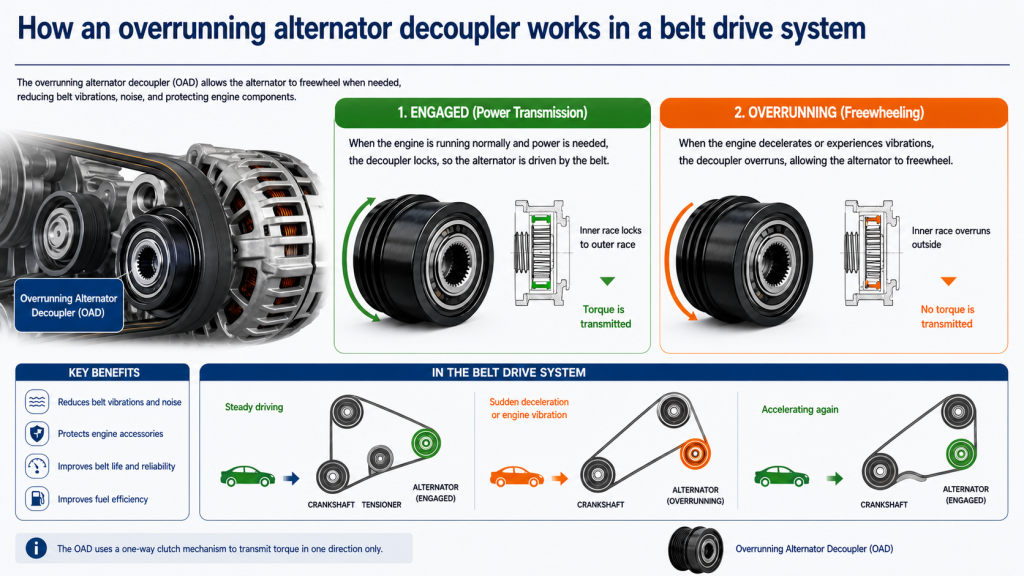
An overrunning alternator decoupler (OAD) helps isolate engine rotational speed fluctuations from the accessory belt drive system. Its internal spring and overrunning clutch allow controlled angular movement between the alternator rotor and pulley, helping reduce belt tension fluctuations, tensioner movement and vibration. Unlike a conventional solid pulley, an OAD provides both overrunning capability and torsional damping.
Engine torsional vibration is a common challenge in modern internal combustion engines. As engines become more compact, efficient, and powerful, controlling vibration within the accessory belt drive system becomes increasingly important. Excessive vibration can lead to belt noise, unstable tensioner operation, premature component wear, and reduced system reliability.
An Overrunning Alternator Decoupler (OAD) plays an important role in managing these issues. By isolating the alternator’s rotational inertia from crankshaft speed fluctuations, an OAD helps reduce vibration transmitted through the accessory drive system.
Together with a Torsional Vibration Damper, an overrunning alternator decoupler contributes to smoother engine operation, improved noise control, and longer component service life.
In this article, we explain how engine torsional vibration occurs, how an overrunning alternator decoupler works, and why selecting the right pulley manufacturer matters for automotive aftermarket and OEM applications.
What Is Engine Torsional Vibration?
Engine torsional vibration refers to the repeated fluctuations in crankshaft rotational speed caused by combustion forces and other dynamic loads during engine operation.
Unlike a perfectly rotating shaft, an engine crankshaft experiences continuous acceleration and deceleration as individual cylinders complete their combustion cycles.
During each combustion event, expanding gases apply torque to the crankshaft, causing a brief acceleration. Between combustion events, the crankshaft slows slightly as it encounters compression forces, friction, and accessory loads.
These repeated torque fluctuations create torsional vibration.
Several factors influence its intensity:
Engine speed: Certain RPM ranges can amplify torsional oscillations.
Cylinder configuration: Different engine designs produce different combustion torque patterns.
Crankshaft design: Shaft stiffness, mass, and geometry influence vibration characteristics.
Accessory loads: Alternators, air-conditioning compressors, and other components affect drivetrain dynamics.
Engine operating conditions: Idling, acceleration, and sudden load changes can increase vibration.
Without effective vibration management, these fluctuations can affect both the crankshaft and the accessory belt drive system.
How Does Engine Torsional Vibration Affect the Belt Drive System?
The crankshaft pulley transfers rotational power to engine accessories through a serpentine belt.
However, crankshaft speed fluctuations can also travel through this belt.
When these fluctuations interact with the rotational inertia of the alternator and other accessories, they can create irregular belt tension and excessive tensioner movement.
Common consequences include belt noise, increased tensioner oscillation, accelerated belt wear, and additional stress on accessory bearings.
Modern accessory drive systems therefore use specialized components to manage these dynamic forces.
One important solution is the overrunning alternator decoupler.
What Is an Overrunning Alternator Decoupler (OAD)?
An Overrunning Alternator Decoupler (OAD) is a specialized alternator pulley designed to reduce the transmission of rotational speed fluctuations between the engine’s accessory belt and the alternator rotor.
Unlike a conventional solid alternator pulley, an OAD incorporates two important functions:
An overrunning clutch mechanism that allows the alternator rotor to continue rotating when belt speed decreases.
A torsional spring mechanism that helps isolate the alternator’s inertia from crankshaft rotational irregularities.
These mechanisms work together to improve the dynamic behavior of the accessory belt drive system.
How Does an OAD Work?
During normal engine operation, the crankshaft drives the serpentine belt, which rotates the alternator pulley.
However, the crankshaft does not rotate at a perfectly constant speed.
When the crankshaft accelerates during combustion, the torsional spring inside the OAD allows limited relative angular movement, reducing the immediate transmission of speed fluctuations to the alternator rotor.
When crankshaft speed decreases, the overrunning mechanism allows the alternator rotor to continue rotating temporarily due to its inertia.
This combination reduces the alternator’s resistance to rapid belt speed changes.
As a result, the accessory drive system experiences smoother operation and reduced dynamic belt loading.
OAD vs. OAP: What Is the Difference?
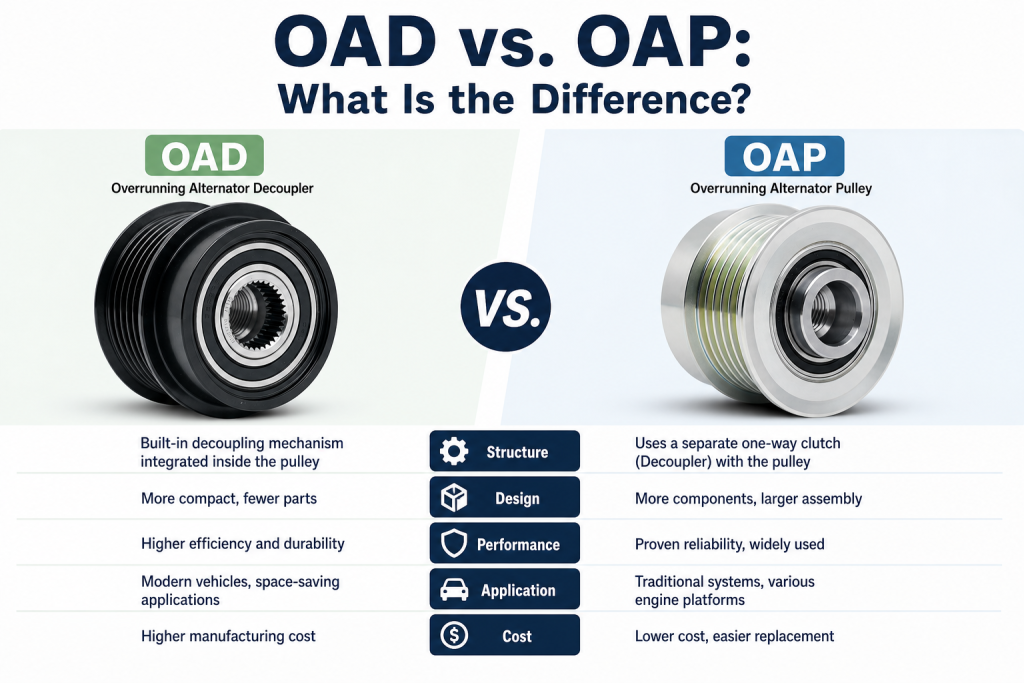
Although both components are designed to improve alternator drive performance, an Overrunning Alternator Decoupler (OAD) and an Overrunning Alternator Pulley (OAP) are not identical.
An OAP primarily uses a one-way clutch mechanism to allow the alternator rotor to overrun when belt speed decreases.
An OAD combines an overrunning mechanism with a torsional spring that provides additional vibration isolation.
Therefore, an OAD can offer greater torsional decoupling capability in applications where crankshaft speed fluctuations significantly affect accessory belt dynamics.
OAD and OAP pulleys are not universally interchangeable. The correct component must be selected according to the vehicle manufacturer’s specifications.
How Does an Overrunning Alternator Decoupler Help Control Engine Torsional Vibration?
An overrunning alternator decoupler does not directly eliminate torsional vibration inside the crankshaft.
Instead, it helps control how crankshaft speed fluctuations affect the alternator and accessory belt drive system.
Its contribution can be explained through five key mechanisms.
1. Isolating Alternator Inertia from Crankshaft Speed Fluctuations
The alternator rotor has significant rotational inertia.
When connected to the crankshaft through a conventional solid pulley, the alternator must follow rapid changes in belt speed.
This can generate additional dynamic forces within the belt drive system.
An OAD reduces this interaction by allowing limited torsional movement between the pulley and alternator shaft.
Its internal spring mechanism absorbs part of the relative rotational displacement, while the overrunning clutch accommodates certain deceleration conditions.
This helps isolate the alternator’s inertia from rapid crankshaft speed fluctuations.
2. Reducing Belt Tension Fluctuations
Engine torsional vibration can cause repeated changes in serpentine belt tension.
These fluctuations become more pronounced when the alternator’s rotational inertia resists sudden changes in belt speed.
By decoupling the alternator from some of these speed variations, an OAD helps reduce dynamic belt tension.
More stable belt tension can contribute to smoother accessory operation and lower mechanical stress.
This is particularly valuable in modern engines with high-output alternators and compact accessory drive layouts.
3. Minimizing Belt Tensioner Oscillation
The automatic belt tensioner maintains appropriate tension throughout the accessory drive system.
However, excessive crankshaft speed fluctuations can cause the tensioner arm to move repeatedly.
Over time, excessive oscillation may accelerate wear in the tensioner mechanism and contribute to unwanted noise.
An overrunning alternator decoupler helps reduce the fluctuating forces acting on the belt.
Consequently, the belt tensioner can operate with less excessive movement under suitable operating conditions.
4. Improving Noise, Vibration, and Harshness (NVH)
Noise, Vibration, and Harshness (NVH) performance is an important consideration in modern vehicle design.
Engine torsional vibration can contribute to several unwanted sounds, including belt squealing, tensioner rattling, and accessory drive noise.
An OAD helps improve NVH performance by reducing the transmission of rotational irregularities through the belt drive.
This can be particularly beneficial during engine idling, low-speed operation, and rapid changes in engine speed.
5. Supporting Longer Accessory Drive Component Life
Excessive vibration and irregular belt tension can increase mechanical loading on multiple components.
These include the serpentine belt, automatic belt tensioner, idler pulleys, and alternator bearings.
By reducing dynamic loading, a properly functioning OAD can help limit unnecessary stress on these components.
However, actual service life depends on vehicle design, operating conditions, component quality, and maintenance practices.
Common Symptoms of a Failing Overrunning Alternator Decoupler
Like other mechanical components, an OAD can deteriorate after extended use.
Common warning signs include:
Excessive belt tensioner movement: A worn or seized decoupler may allow greater dynamic loading within the belt system.
Rattling or squealing noises: Abnormal pulley operation can contribute to unwanted accessory drive noise.
Premature serpentine belt wear: Irregular belt tension may accelerate belt deterioration.
Abnormal pulley behavior: A damaged clutch or spring mechanism may prevent the OAD from functioning correctly.
Increased vibration at idle: A malfunctioning decoupler may reduce vibration isolation, particularly at low engine speeds.
These symptoms can also result from other accessory drive problems.
Therefore, proper diagnosis is necessary before replacing the alternator decoupler.
Technicians should follow vehicle-specific inspection procedures and use appropriate pulley testing tools when required.
How to Choose a Reliable Overrunning Alternator Decoupler Manufacturer
For automotive parts importers, wholesalers, and aftermarket brands, choosing a dependable supplier is essential for maintaining product quality and customer satisfaction.
Several factors deserve attention.
OE-Compatible Fitment and Product Coverage
Alternator decoupler pulleys must match the requirements of specific alternator models and engine applications.
Important specifications include pulley diameter, groove configuration, shaft interface, and internal operating characteristics.
A manufacturer offering comprehensive product coverage can help distributors source compatible components for different vehicle brands and engine platforms.
Material Quality and Precision Manufacturing
The performance of an OAD depends on the quality of its internal clutch, spring, bearings, and precision-machined components.
Suitable materials, controlled manufacturing processes, and accurate dimensional tolerances contribute to consistent operation.
For crankshaft dampers, metal component quality, elastomer properties, bonding integrity, and dimensional accuracy are particularly important.
Quality Management and Production Consistency
Automotive components require repeatable manufacturing quality.
A supplier operating under established automotive quality management systems can provide greater confidence in process control and product consistency.
Manufacturers should also be able to communicate product specifications, compatibility information, and quality requirements clearly.
OEM/ODM Development Capabilities
Different markets may require different pulley configurations and vehicle applications.
Suppliers offering OEM/ODM manufacturing and drawing-based customization can help automotive brands develop products for specific market requirements.
This flexibility is especially valuable for distributors expanding their product portfolios.
Why Choose Fuyide for Alternator Pulleys and Alternator Decoupler Pulleys?
Changzhou Fuyide Precision Machinery Co., Ltd. is a China-based manufacturer specializing in precision mechanical components and automotive parts, including alternator pulleys and Alternator Decoupler pulleys.
Located in Changzhou, China, Fuyide combines precision manufacturing capabilities with automated production equipment and professional R&D resources.
The company focuses on delivering reliable, cost-effective automotive components to customers in international markets.
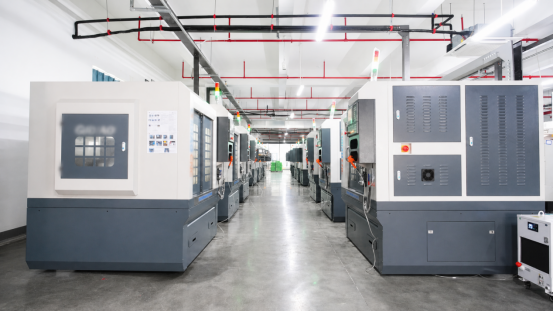
(Precision Engraving Process of the Retainer, a Component of Fuyide 6-Series OAD Pulley.)
OE-Oriented Manufacturing Standards
Fuyide emphasizes material selection, dimensional accuracy, and manufacturing consistency.
Its product development and manufacturing approach is guided by OE-oriented quality requirements, helping support compatibility with corresponding original equipment applications.
IATF 16949 and ISO 9001 Quality Management
Since 2019, Fuyide has achieved ISO 9001 and IATF 16949 quality management system certifications.
These management systems support standardized processes, production consistency, and continuous improvement.
Comprehensive Automotive Pulley Solutions
Fuyide offers a broad range of automotive pulley products, including:
Overrunning Alternator Pulleys
Alternator Decoupler Pulleys
Its product portfolio supports various vehicle brands and engine applications, helping importers and wholesalers simplify sourcing.
Competitive Pricing and Flexible Customization
Fuyide aims to deliver competitive pricing while maintaining consistent product quality.
The company also supports OEM/ODM projects and drawing-based product development.
Customization projects generally start from 100 pieces, subject to product requirements.
Typical bulk order lead times are approximately 30–45 days, depending on order specifications and production arrangements.
For automotive parts importers, distributors, and private-label brands, Fuyide provides a manufacturing partner focused on quality, product coverage, and supply reliability.
Frequently Asked Questions About Engine Torsional Vibration
Can an Overrunning Alternator Decoupler Eliminate Engine Torsional Vibration?
No. An overrunning alternator decoupler does not eliminate crankshaft torsional vibration.
Instead, it reduces the transmission of rotational speed fluctuations between the accessory belt and alternator rotor, helping improve belt drive stability.
Can a Faulty OAD Cause Belt Tensioner Vibration?
Yes. A seized or damaged OAD may increase dynamic belt loading and contribute to excessive tensioner movement.
However, other issues, including worn tensioners, damaged belts, and pulley misalignment, can produce similar symptoms.
When Should an Alternator Decoupler Pulley Be Replaced?
An alternator decoupler should be inspected when abnormal belt noise, excessive tensioner movement, or pulley malfunction occurs.
Replacement should follow vehicle manufacturer recommendations and appropriate diagnostic procedures.
Conclusion
Controlling Engine Torsional Vibration is essential for maintaining a stable and reliable automotive accessory drive system.
An Overrunning Alternator Decoupler helps manage the effects of crankshaft speed fluctuations by isolating alternator inertia, reducing dynamic belt loading, and improving accessory drive NVH performance.
Meanwhile, a properly designed Crankshaft Torsional Damper addresses torsional oscillations within the crankshaft system itself.
Together, these components contribute to smoother operation and reduced mechanical stress.
For automotive parts importers, wholesalers, aftermarket brands, and OEM customers, selecting high-quality pulleys from a reliable manufacturer is an important part of delivering dependable replacement solutions.
Looking for a reliable alternator pulley or alternator decoupler pulley manufacturer?
Contact Fuyide to explore our automotive pulley product range, discuss vehicle compatibility requirements, or request an OEM/ODM manufacturing quotation.
Related Products
Frequently Asked Questions
How does an OAD pulley reduce vibration?
An OAD pulley helps reduce vibration in the accessory belt drive by isolating engine rotational speed fluctuations from the alternator rotor. Its internal torsion spring provides controlled angular flexibility, while the overrunning clutch allows the alternator rotor to overrun during deceleration.
What is the difference between an OAD and an OAP?
An overrunning alternator pulley (OAP) uses a one-way clutch to allow the alternator rotor to overrun during engine deceleration. An overrunning alternator decoupler (OAD) combines an overrunning mechanism with torsional spring functionality to provide additional vibration isolation.
Can a failing OAD cause belt tensioner vibration?
Yes. A worn or seized OAD can contribute to excessive belt tensioner movement, abnormal belt vibration and noise. However, similar symptoms may also result from worn tensioners, damaged belts or other accessory drive components, so proper inspection is necessary.