


Quick answer
A reliable overrunning alternator pulley (OAP) manufacturer should demonstrate consistent manufacturing capability, machining precision, material control, durability testing, automotive quality management, broad vehicle coverage, customization capability, and stable delivery. For distributors and importers, evaluating these factors together helps identify a supplier suitable for long-term aftermarket supply.
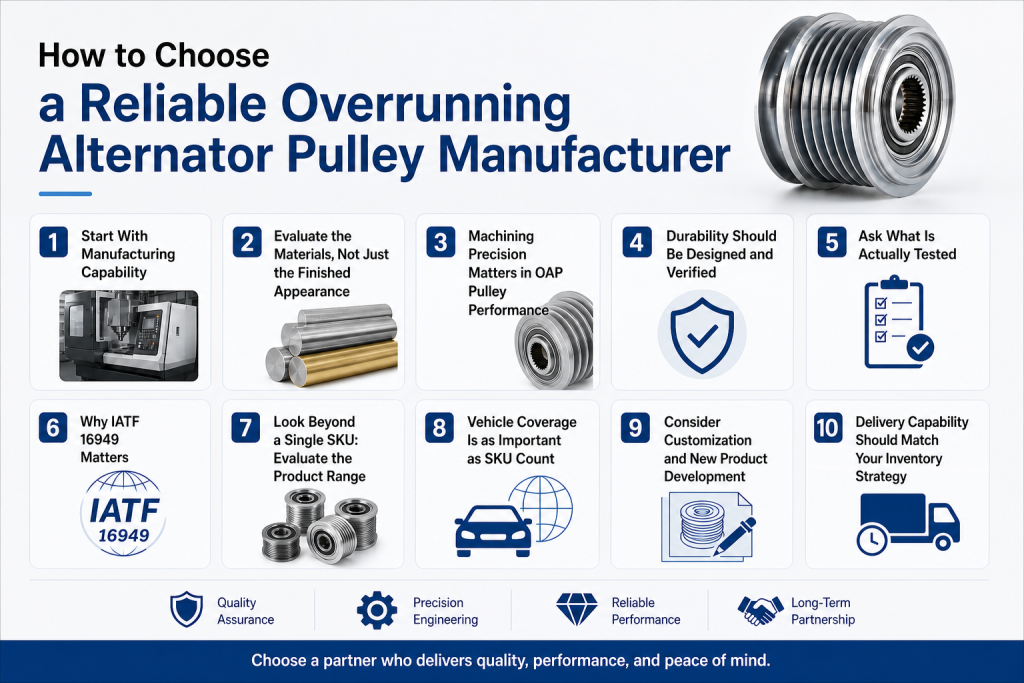
Choosing an Overrunning Alternator Pulley Manufacturer is not simply a matter of comparing unit prices.
For automotive aftermarket distributors, importers, wholesalers, and private-label brands, an OAP pulley is a precision mechanical component that must perform reliably under repeated rotational loads, vibration, temperature changes, and demanding engine conditions. Product consistency can directly affect warranty claims, customer satisfaction, and the reputation of your aftermarket brand.
When sourcing from an OAP Pulley Manufacturer, buyers should therefore look beyond the quotation. Manufacturing capability, materials, machining precision, durability testing, quality management, product range, vehicle coverage, customization, and delivery capability should all be part of the supplier evaluation process.
This guide explains what B2B buyers should examine before selecting a long-term OAP pulley manufacturing partner.
1. Start With Manufacturing Capability
The first question to ask a potential supplier is straightforward: does the company actually have the manufacturing capability required for consistent OAP pulley production?
An overrunning alternator pulley contains a one-way mechanism designed to allow the alternator to overrun during certain operating conditions. Compared with a simple solid pulley, its functional reliability depends more heavily on component accuracy, assembly consistency, and process control.
When evaluating an Overrunning Alternator Pulley Manufacturer, buyers should examine its capabilities in areas such as machining, assembly, production automation, process control, and final inspection.
A supplier may be able to produce a good sample. The more important B2B question is whether it can reproduce the same level of quality across hundreds or thousands of units.
For distributors, stable mass-production capability matters more than an impressive prototype.
2. Evaluate the Materials, Not Just the Finished Appearance
Two OAP pulleys can look almost identical while performing very differently over time.
Materials used in load-bearing and wear-sensitive components influence mechanical strength, wear resistance, fatigue life, and long-term operating stability.
Buyers should discuss with the manufacturer how materials are selected for different pulley components and applications. Material specifications should also be considered together with heat treatment, surface treatment, machining, and other manufacturing processes where applicable.
This is particularly important for buyers comparing different suppliers based primarily on price.
A lower quotation can sometimes result from differences that are difficult to identify visually. For professional aftermarket sourcing, understanding what is inside the product is just as important as checking its external dimensions.
3. Machining Precision Matters in OAP Pulley Performance
Precision is one of the most important criteria when selecting an OAP Pulley Manufacturer.
An overrunning alternator pulley works as part of a complete accessory drive system. Dimensions, threads, grooves, concentricity, internal component tolerances, and assembly accuracy can influence installation and operation.
The manufacturing process should therefore control critical dimensions consistently rather than relying only on final visual inspection.
For B2B buyers, useful questions include:
Which critical dimensions are controlled during production?
What measuring equipment is used?
How is process consistency monitored?
Are dimensional inspection records available when required?
How are non-conforming products identified and handled?
How is batch-to-batch consistency maintained?
A reliable manufacturer should be able to discuss precision in measurable manufacturing terms, rather than simply stating that its products are “high quality.”
4. Durability Should Be Designed and Verified
An OAP pulley does not operate under static conditions.
During vehicle operation, the pulley experiences repeated rotational changes, vibration, loads, and temperature variations. This makes durability an important consideration for aftermarket distributors, especially when products are sold under their own brand.
Premature failure can result in warranty costs and additional logistics, while repeated quality issues can damage relationships between distributors and their customers.
When qualifying an Overrunning Alternator Pulley Manufacturer, buyers should therefore understand how the company evaluates product life and functional reliability.
Depending on the product and application, evaluation may include functional testing, torque-related testing, dimensional inspection, durability testing, and other appropriate verification procedures.
The important point is that durability should be supported by controlled manufacturing and verification rather than assumptions based on appearance.
5. Ask What Is Actually Tested
The word “tested” is common in automotive parts marketing, but B2B buyers should ask a more useful question:
What exactly is tested, at what stage, and according to what criteria?
Testing can take place during incoming material inspection, production, assembly, or final product inspection. Different characteristics may also require different equipment and inspection methods.
When assessing an Alternator Pulley Manufacturer China buyers are considering for long-term cooperation, it is useful to understand the supplier’s testing equipment, inspection procedures, sampling standards, quality records, and traceability practices.
A defined inspection process provides more meaningful information than a generic promise that every product is “quality checked.”
6. Why IATF 16949 Matters
Quality management system certification is another important factor in automotive sourcing.
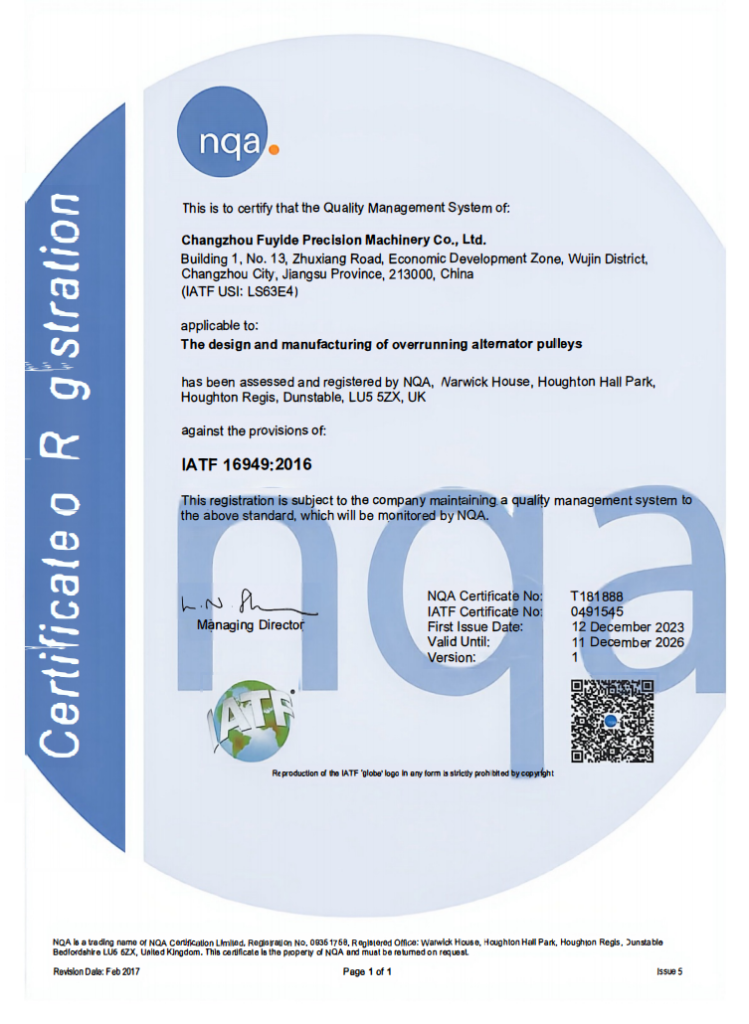
IATF 16949 is specifically associated with quality management requirements in the automotive supply chain. It emphasizes areas including process control, risk management, traceability, defect prevention, continuous improvement, and reduction of variation and waste.
Certification itself does not mean that buyers should stop evaluating actual products or manufacturing processes. It should instead be considered part of a wider supplier qualification process.
For importers and distributors evaluating an OAP Pulley Manufacturer, a manufacturer operating within an automotive-oriented quality management framework can provide additional confidence in how production and quality processes are managed.
Buyers should also verify certification details and scope directly when supplier qualification requires it.
7. Look Beyond a Single SKU: Evaluate the Product Range
For distributors, sourcing one OAP pulley successfully is useful. Building a complete, commercially viable pulley range is much more valuable.
A supplier with limited SKU coverage may force buyers to work with multiple manufacturers to complete their catalog.
This increases procurement complexity through additional:
Supplier qualification
MOQs and purchase orders
Quality agreements
Shipping arrangements
Product documentation
Inventory planning
Communication and after-sales handling
Therefore, when selecting an Overrunning Alternator Pulley Manufacturer, distributors should review not only the specific product they currently need but also the manufacturer’s overall product series.
A broader and structured range can make future catalog expansion significantly easier.
8. Vehicle Coverage Is as Important as SKU Count
A long product list does not necessarily equal strong aftermarket coverage.
The real question is whether those SKUs correspond to the vehicle applications relevant to your target market.
Depending on the region, distributors may require coverage across different European, Asian, or other vehicle platforms. Applications can also differ according to vehicle model, engine, model year, and alternator configuration.
This is why vehicle application information and OE cross-reference capabilities are important when evaluating an OAP Pulley Manufacturer.
For aftermarket buyers, the goal should be practical coverage rather than simply maximizing the number of part numbers.
Before placing a larger order, buyers can provide their existing OE number list or target application list and compare it with the manufacturer’s available range. This is often a more effective way to evaluate supplier coverage.
9. Consider Customization and New Product Development
Standard catalog products may cover most requirements, but B2B customers sometimes need more.
A private-label customer may require customized packaging and identification. A distributor may discover an application that is not yet included in the manufacturer’s existing range. Customers in different markets may also have different product development priorities.
This makes R&D and customization capability another factor in supplier selection.
Useful capabilities may include product development based on samples or technical information, new SKU development, product marking, packaging support, and other OEM/ODM requirements.
Not every purchasing project requires customization. However, knowing that a manufacturing partner can support future requirements can be valuable for long-term supplier relationships.
10. Delivery Capability Should Match Your Inventory Strategy
Good quality is not enough if the product cannot be supplied when the market needs it.
Delivery performance is particularly important for distributors managing dozens or hundreds of SKUs. Different products may have different demand levels, and maintaining excessive safety stock increases working capital requirements.
When evaluating an Alternator Pulley Manufacturer China sourcing partner, buyers should discuss production capacity, typical lead times, order planning, MOQ requirements, and replenishment arrangements.
For a long-term supply program, stable delivery can be just as important as initial price.
The objective is not simply to receive one container or one order on time. It is to build a repeatable supply process that supports ongoing inventory replenishment.
FUYIDE as an OAP Pulley Manufacturing Partner
Once these criteria are applied, supplier selection becomes much more systematic.
Changzhou Fuyide Precision Machinery Co., Ltd. (FUYIDE) is located in Changzhou, in China’s Yangtze River Delta, and specializes in precision mechanical products and automotive components.
FUYIDE has continuously invested in professional personnel, production equipment, testing equipment, R&D capabilities, and automated production lines. Through years of manufacturing development, the company has worked toward standardized management processes, standardized production, and serialized product development.
For customers searching for an Overrunning Alternator Pulley Manufacturer, FUYIDE’s approach is built around more than individual part numbers. The company continues to develop its OAP and alternator pulley product series to support broader aftermarket applications and sourcing requirements.
This makes it possible to work with distributors, importers, wholesalers, and automotive aftermarket brands requiring multiple SKUs and vehicle applications rather than only individual products.
FUYIDE has held ISO 9001 and IATF 16949 quality management system certifications since 2019, supporting standardized quality management throughout its automotive component manufacturing activities.
From Product Samples to Long-Term Supply
Supplier qualification should not end with a catalog and quotation.
For serious B2B sourcing, buyers can use a staged process: review the manufacturer and its quality system, check OE and application coverage, evaluate technical specifications and samples, verify testing and manufacturing capabilities, and then assess trial-order consistency before moving toward larger-volume cooperation.
This approach helps distinguish between a supplier that can deliver a suitable sample and a manufacturing partner capable of supporting repeat business.
FUYIDE can support customers with product information, OE cross-reference matching, application discussions, samples, and product range evaluation according to specific sourcing projects.
Choosing the Right Overrunning Alternator Pulley Manufacturer
The right OAP supplier should fit both your technical requirements and your supply-chain strategy.
When comparing an OAP Pulley Manufacturer, buyers should consider manufacturing capability, material selection, machining precision, durability, testing, automotive quality management, product coverage, customization, and delivery performance together.
For distributors and importers, this broader evaluation can help reduce sourcing risk while creating a more scalable aftermarket product program.
If you are currently looking for an Overrunning Alternator Pulley Manufacturer or an Alternator Pulley Manufacturer in China, contact FUYIDE with your OE numbers, target vehicle applications, samples, or required specifications.
Our team can help you evaluate product matching, available OAP pulley coverage, and sourcing options for your market.
Related Products
Frequently Asked Questions
How do I choose a reliable overrunning alternator pulley manufacturer?
Check the manufacturer's production capability, machining precision, material control, testing procedures, quality management system, product coverage, customization capability, and delivery performance. For long-term sourcing, also evaluate samples and trial-order consistency.
What should I check when sourcing OAP pulleys from a China manufacturer?
Buyers should review manufacturing capability, inspection and testing procedures, IATF 16949 or other applicable quality certifications, OE cross-reference coverage, MOQ, lead time, production capacity, and batch-to-batch consistency.
Can an OAP pulley manufacturer provide custom products or new SKUs?
Yes, depending on the manufacturer's capabilities. Custom requirements may include new SKU development, product marking, packaging, private-label support, and product development based on samples or technical specifications.
How can I confirm whether an OAP manufacturer can support my aftermarket product range?
Provide your OE number list, target vehicle applications, samples, or technical specifications and compare them with the manufacturer's available OAP range. This helps verify product matching, vehicle coverage, and future catalog expansion capability.