


Quick answer
An overrunning alternator pulley (OAP) can be checked by observing belt and tensioner behavior with the engine running, then performing a manual one-way clutch test with the engine switched off and belt tension released. A properly functioning OAP should engage in the drive direction and overrun smoothly in the opposite direction; if it locks both ways, freewheels incorrectly, feels rough, or shows excessive play, further inspection or replacement may be required.
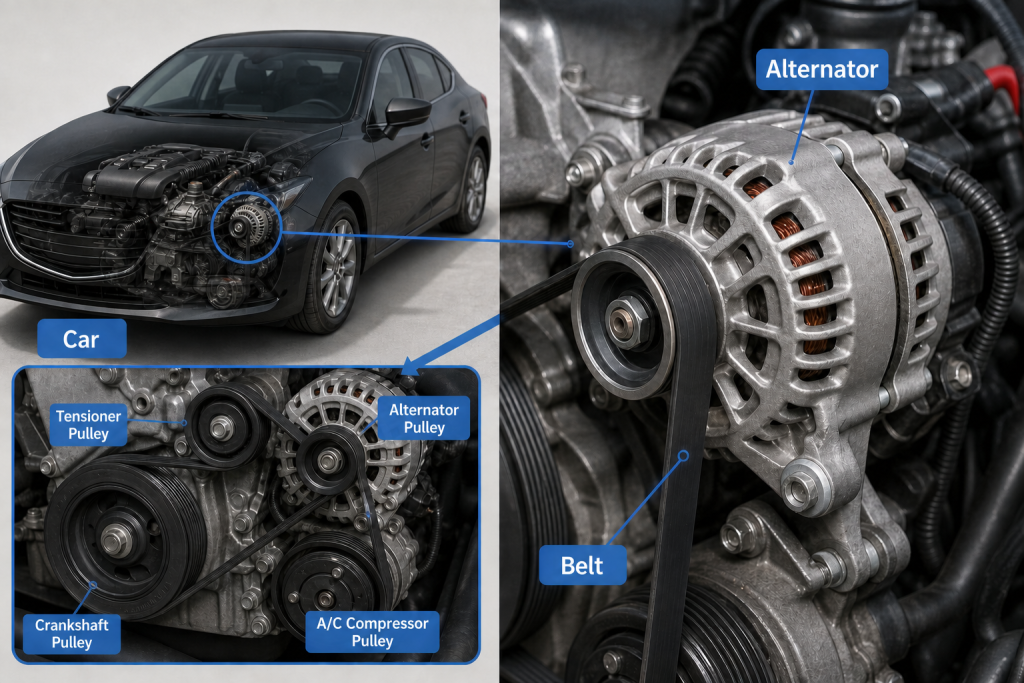
An overrunning alternator pulley (OAP) is a small but important part of the vehicle’s accessory belt drive system. Unlike a conventional solid alternator pulley, an OAP contains an internal one-way clutch that allows the alternator to overrun when engine speed drops rapidly. This helps reduce belt vibration, tensioner movement, noise, and stress on other drive components.
When an OAP begins to wear or seize, the symptoms can sometimes be mistaken for problems with the belt, tensioner, or alternator itself. In this guide, Fuyide explains how to test overrunning alternator pulley condition, how to check OAP pulley operation, and what symptoms may indicate that replacement is needed.
What Is an Overrunning Alternator Pulley?
An overrunning alternator pulley is designed to transmit engine torque to the alternator in the drive direction while allowing the alternator rotor to continue rotating temporarily when engine speed decelerates.
Because the alternator rotor has significant rotational inertia, a conventional fixed pulley can transmit this force back into the belt system during sudden engine-speed changes. An OAP helps isolate these forces.
A properly functioning OAP can help:
Reduce accessory belt vibration and slip
Improve belt tensioner stability
Reduce noise from the FEAD (Front End Accessory Drive)
Reduce stress on the belt, tensioner, and related components
Improve overall accessory drive system operation
Note that an OAP is not the same as every type of decoupling pulley. An Overrunning Alternator Decoupler (OAD), for example, usually incorporates additional torsional isolation functionality. Correct pulley identification is important before diagnosis or replacement.
Common Symptoms of a Bad OAP Pulley
Before performing an alternator pulley test, look for symptoms that may indicate pulley wear or internal clutch failure.
Common signs include excessive belt tensioner movement at idle, belt vibration, chirping or rattling noises, unusual noise during engine shutdown, premature belt wear, or abnormal pulley operation.
A failed OAP can generally fail in two ways. It may seize, causing it to behave more like a solid pulley, or it may lose its ability to lock properly in the drive direction. Either condition can affect accessory belt performance.
These symptoms do not automatically prove that the pulley is defective. Belt alignment, a worn tensioner, alternator bearings, crankshaft pulley condition, and other accessory components should also be considered.
How to Check OAP Pulley Condition on the Vehicle
A preliminary inspection can be performed before removing the alternator pulley.
First, start the engine and observe the serpentine belt and automatic tensioner at idle. Some movement can be normal, but unusually aggressive or repetitive tensioner oscillation can be an indication that the alternator pulley is no longer isolating rotational irregularities correctly.
Listen for abnormal chirping, rattling, or belt noise, especially during rapid changes in engine speed and during shutdown.
When the engine is switched off, the alternator rotor has rotational inertia and may continue moving momentarily if the OAP is functioning correctly. However, visual observations alone are not sufficient for a definitive diagnosis.
Never place your hands or tools near a moving belt or pulley. Any manual alternator pulley test should be performed with the engine switched off and the vehicle secured against accidental starting.
How to Test Overrunning Alternator Pulley by Hand
For a more reliable OAP test, access to the pulley and alternator shaft is required. Depending on the vehicle, this may require removing the serpentine belt or removing the alternator.
The basic principle is straightforward: a functional OAP should lock in one rotational direction and overrun relatively freely in the opposite direction.
To perform the test:
Switch off the engine, remove the key, and ensure the engine cannot start accidentally.
Remove belt tension according to the vehicle manufacturer’s procedure.
Gain safe access to the alternator pulley.
Secure or hold the alternator rotor/shaft using the correct service tool where required.
Rotate the pulley carefully in each direction.
Verify that the pulley locks in the drive direction and overruns smoothly in the opposite direction.
The exact clockwise or counterclockwise direction can vary depending on the alternator and application. For this reason, do not diagnose an OAP based solely on a generic rotation direction. Confirm the operating direction using the alternator, pulley, or vehicle manufacturer’s specifications.
How to Interpret the Alternator Pulley Test
During an alternator pulley test, pay attention to more than whether the pulley simply rotates.
A normal OAP should exhibit its intended one-way clutch behavior: engagement in the drive direction and relatively smooth overrunning in the free direction.
The pulley may require replacement if it:
Rotates freely in both directions
Locks in both directions when it should overrun in one
Feels rough, sticky, or inconsistent
Produces grinding or unusual mechanical noise
Shows excessive looseness or physical damage
If the pulley locks in both directions, the clutch mechanism may be seized. If it spins in both directions without properly driving the rotor, the clutch may no longer be engaging.
Always compare the results with the specifications for the specific pulley design.
Can You Test an OAP Without Removing It?
In many applications, an initial how to check OAP pulley inspection can be performed without removing the pulley itself. Observing belt tensioner behavior and shutdown characteristics can provide useful clues.
For a more conclusive mechanical check, however, the belt usually needs to be released or removed so belt tension does not interfere with pulley movement.
Professional OAP tool sets can make testing and removal easier. These tools typically allow the pulley and alternator shaft to be controlled independently.
OAP Pulley Testing Mistakes to Avoid
One common mistake is assuming all alternator pulleys operate the same way. Conventional solid pulleys, OAPs, and OADs have different operating characteristics.
Another mistake is replacing the belt or tensioner without checking the alternator pulley. A seized OAP may cause belt-system symptoms that appear to originate from another component.
It is also important not to force the pulley with an unsuitable tool. Incorrect tooling can damage the pulley, alternator shaft, internal components, or protective cap.
Most importantly, never perform a manual pulley check while the engine is running.
When Should an Overrunning Alternator Pulley Be Replaced?
There is no universal replacement interval for every OAP because service life depends on vehicle design, operating conditions, belt system condition, and pulley construction.
Replacement should be considered when testing confirms incorrect one-way clutch operation, or when the pulley has excessive wear, noise, play, seizure, or physical damage.
When replacing an OAP, check the rest of the accessory drive system as well. Inspect the serpentine belt, tensioner, idlers, pulley alignment, and alternator condition. This can help identify related problems and prevent repeated component failure.
Choosing the Correct Replacement OAP
Correct matching is essential when selecting an overrunning alternator pulley. Important specifications can include pulley dimensions, groove number, thread or mounting design, alternator application, vehicle model, engine type, and OE or cross-reference number.
A replacement pulley should not be selected on outside diameter alone. Two OAPs can appear similar but have different internal interfaces or application requirements.
Fuyide manufactures automotive pulley products for aftermarket and distribution applications. For buyers, importers, and distributors sourcing overrunning alternator pulleys, confirming the OE number and technical specifications helps ensure the appropriate product is selected for each application.
Frequently Asked Questions
How to test overrunning alternator pulley operation?
With the engine safely off and belt tension removed, the pulley and alternator rotor can be checked independently using the appropriate tool. A typical OAP should engage in its drive direction and overrun in the opposite direction. Always verify the specified operating direction for the particular application.
How to check OAP pulley without removing the alternator?
Start with a visual inspection of belt and tensioner behavior while the engine is operating. For manual testing, switch the engine off and release the serpentine belt according to the vehicle service procedure. Some vehicles provide enough access to test the OAP without removing the alternator.
What happens if the overrunning alternator pulley is seized?
A seized OAP cannot perform its intended overrunning function. This can increase belt-system vibration and tensioner movement and may contribute to noise or accelerated wear of drive components.
Should an OAP spin both ways?
A typical OAP should not simply freewheel in both directions. Its one-way clutch is designed to transmit torque in one direction and permit overrunning in the other. Exact behavior should always be checked against the pulley manufacturer’s specifications.
Conclusion
Knowing how to test overrunning alternator pulley condition can help distinguish an OAP problem from faults involving the belt, tensioner, alternator, or other accessory-drive components.
The key principle of an OAP alternator pulley test is to verify correct one-way clutch operation: the pulley should engage as designed in the drive direction while allowing overrunning in the opposite direction. If the pulley is seized, freewheels incorrectly, feels rough, or has excessive play, further inspection or replacement may be necessary.
For professional automotive parts buyers looking for OAP pulleys and related pulley solutions, Fuyide can support product matching based on OE references, dimensions, and application requirements.
Related Products
Frequently Asked Questions
How do you test an overrunning alternator pulley?
With the engine switched off and the belt tension released, check the pulley using the appropriate service tool. A typical OAP should lock in the specified drive direction and overrun smoothly in the opposite direction. Always verify the operating direction for the specific alternator and pulley application.
How can you tell if an OAP pulley is bad?
Common signs of a faulty OAP include excessive tensioner movement, belt vibration, chirping or rattling noise, abnormal shutdown noise, rough pulley movement, incorrect one-way clutch operation, excessive play, or a seized pulley. These symptoms should be checked together with the belt, tensioner, alternator, and other accessory-drive components.
Should an overrunning alternator pulley spin both ways?
A typical OAP should not simply spin freely in both directions. Its internal one-way clutch is designed to transmit torque in the drive direction while allowing the alternator to overrun in the opposite direction. The exact operating direction depends on the specific application.
How do I choose the correct replacement OAP pulley?
Confirm the OE or cross-reference number, alternator application, pulley dimensions, groove number, mounting or thread specification, vehicle model, and engine information. Do not select an OAP based only on outside diameter because similar-looking pulleys may have different internal interfaces and applications.